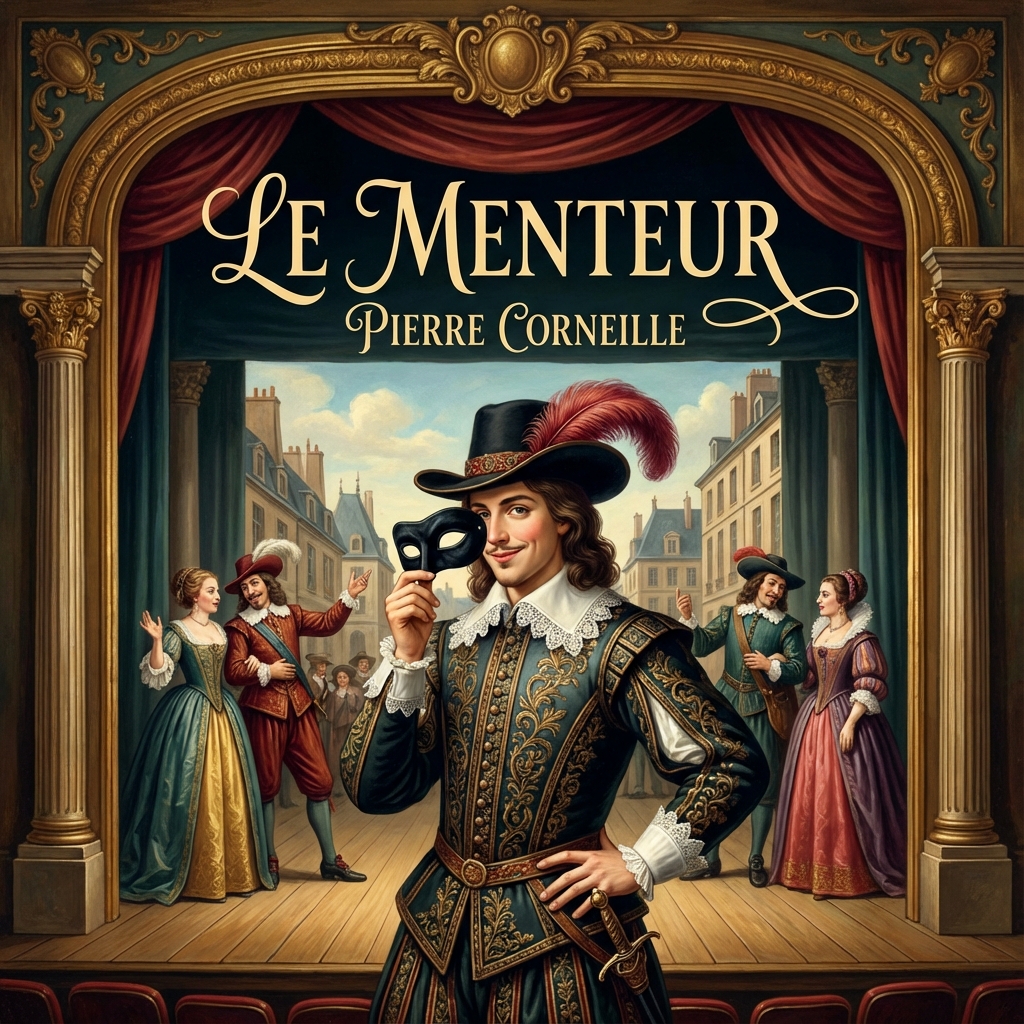
The Liar
"Il faut bonne mémoire après qu'on a menti." (One needs a good memory after telling lies.)
Biography of Pierre Corneille (1606-1684)
Key Dates
Youth and Education (1606-1629)
- 1606: Born in Rouen to a bourgeois family of legal professionals.
- Studies: Excellent education with the Jesuits (Latin, rhetoric). He pursued law and became a lawyer, though without passion.
- 1629: He wrote his first comedy, Mélite, as a romantic challenge. It was an immediate success in Paris and launched his career.
Rise and Glory (1630-1643)
- Comedies: He renewed the genre with La Place Royale and L'Illusion comique (1636), blending magic and theater.
- 1637: Le Cid: His tragi-comic masterpiece. Enormous public success but violent controversy ("La Querelle du Cid") over respect for classical rules (verisimilitude, propriety).
- Great Tragedies: In response to criticism, he wrote regular Roman tragedies: Horace (1640), Cinna (1641), Polyeucte (1642).
- 1643: Le Menteur: He returned brilliantly to comedy, adapting a Spanish play by Alarcón. He invented the French "comedy of character."
Later Career
- The Academy: Elected in 1647.
- The Fronde: A troubled period when he stopped writing for several years after the failure of Pertharite.
- The Return: He came back with Œdipe (1659) and theorized his art in his Three Discourses on Dramatic Poetry.
- Rivalry: Late in life, he faced competition from the young Jean Racine. He died in 1684.
His Aesthetic: Cornelian Heroism
Heroism and Will
The Cornelian hero is defined by his will. He is master of himself. Unlike the Racinian hero (victim of his passions), the Cornelian hero asserts his freedom through difficult choices ("Cornelian dilemma").
Cornelian Comedy
In Le Menteur, Corneille applies this energy to the comic register. Dorante is a "heroic" liar through his capacity for invention and mastery of language. Corneille seeks less the buffoonish laugh (farce) than the smile of wit (gallant and urbane comedy).
Detailed Summary: The Liar
Act I: The Tuileries (The First Lie)
Fresh from Poitiers where he has just completed his
law studies, young Dorante discovers the excitement
of Paris. Accompanied by his valet Cliton, he has
only one ambition: to make his mark and conquer
hearts. To impress the ladies, he decides to adopt a
more prestigious role than that of a student: he
will pass himself off as a military man, a soldier
just back from war.
At the Tuileries, a fashionable promenade spot, he
crosses paths with two young women, Clarice and
Lucrèce. Clarice, though engaged to Alcippe, doubts
her feelings. Dorante approaches her boldly, but a
misunderstanding sets in from the start: he confuses
their names and believes he's addressing Lucrèce
when he's actually speaking to Clarice.
To dazzle her, he deploys his talent for
fabrication: he invents a thrilling Parisian life,
claiming to have been there for a year and taking
credit for a sumptuous feast held the previous
evening on the water (a feast actually organized by
his rival Alcippe). The charm works, and Clarice is
intrigued by this mysterious seducer.
Act II: Place Royale (The Spiral)
Alcippe, Clarice's actual lover, is jealous because
he has heard that the feast he organized is being
attributed to someone else. He meets Dorante.
Dorante, not knowing that Alcippe was the organizer,
firmly insists to him that he, Dorante, gave the
feast. Alcippe, furious and disoriented by such
boldness, challenges him to a duel.
Meanwhile, Dorante's father, Géronte, arrives in
Paris to marry his son to... Clarice (the real one).
Dorante, who believes he loves "Lucrèce" (actually
Clarice), is delighted by his father's proposal but,
because of the name confusion, thinks his father
wants to marry him to the other girl. To escape this
"imposed" marriage, he invents a new enormous lie:
he's already married! He tells his father about a
forced secret marriage in Poitiers with a certain
Orphise.
Act III: Complications
The lies intersect.
1. Alcippe breaks up with Clarice out of
jealousy.
2. Clarice, piqued, becomes interested in
Dorante.
3. Géronte announces to Clarice's family that his
son is already married (the false marriage). Clarice
is disappointed.
Dorante, still convinced he loves "Lucrèce" (the
silent girl), learns he was deceived about the
names. He understands that the one he loves is
actually Clarice. But he just told his father he was
married to avoid marrying Clarice! He's caught in
his own trap.
Act IV: The Height of Art
Géronte discovers the truth: there was never a
marriage in Poitiers. Furious at being ridiculed, he
confronts his son.
Dorante, cornered, doesn't lose his composure. He
admits to lying... but out of love! He claims he
invented this marriage to avoid marrying Clarice
because he's in love with... Lucrèce (the real one
this time, whom he decides to love out of
opportunism or change of heart). His father,
softened by this "sincerity," agrees to ask for
Lucrèce's hand.
Act V: The Resolution (Night)
Everyone meets under the balconies.
Clarice reveals to Dorante that she's the one he's
been courting all along. She's ready to marry him.
But Dorante has committed himself to Lucrèce (the
real one) through his father.
Through a final twist, Dorante declares that it's
Lucrèce he's loved from the beginning (a new lie
that becomes truth?). Clarice reconciles with
Alcippe. Dorante marries Lucrèce, satisfied with her
fortune and beauty.
The play closes with Cliton's ambiguous moral:
"Through his feint [the liar] acquires the real
[wife]."
Overall Analysis: The Liar
About the Work
Created in 1643, Le Menteur is a comedy in 5 acts written in verse (alexandrines - twelve-syllable rhymed couplets). It marks a turning point in theater history: Corneille, already famous for his tragedies (Le Cid), proves he can also excel in refined comedy. He draws inspiration from La Verdad sospechosa by the Spanish playwright Alarcón but adapts the plot to Parisian manners (the setting is the Tuileries and Place Royale).
Structure and Plot
The action takes place in Paris over 24 hours.
* The initial misunderstanding:
Dorante, a young law student fresh from Poitiers,
passes himself off as a military man to seduce. He
confuses two young women, Clarice and Lucrèce. He
believes he's courting one when he's speaking to the
other.
* The escalation of lies: To
support his first lie, Dorante must invent others
(about his wealth, his exploits, a forced marriage
in Poitiers).
* The resolution: The truth comes
out, but Dorante's wit saves the day. He ends up
marrying Lucrèce (whom he loved believing she was
Clarice), proving that love can arise from
misunderstanding.
The Dramatic Project: Lies and Theater
1. The Liar as Author
Dorante is not a vicious or calculating liar (like Tartuffe). He's an artistic liar. He lies to embellish reality, to create a character for himself. In this, he's the playwright's double: he invents stories, creates settings, and manipulates other characters. The lie here is a metaphor for theater (comic illusion).
2. Satire of Worldly Life
The play depicts the gilded youth of Paris under
Louis XIII.
* Appearance: In this world,
clothes make the man. Dorante changes costume to
change identity.
* Gallantry: Amorous language is
codified, precious, but often empty of real
meaning.
* Money: Marriages are business
affairs (Dorante's father, Géronte, mainly seeks a
wealthy daughter-in-law).
3. The Transition from Baroque to Classical
- Baroque aspects: Instability, disguise, illusion, movement (changing locations in Paris).
- Classical aspects: Regularity of verse, unity of action (everything revolves around Dorante's lies), propriety (no coarseness).
Conclusion
Le Menteur is more than a farce. It's a "comedy of character" that questions the relationship between truth and fiction. If Dorante lies, it's perhaps because social reality is too dull. Corneille tells us that theater (consensual lying) is necessary for life.
Main Themes: The Liar
1. Truth and Lies
This is the eponymous theme.
* Aesthetic lies: For Dorante,
lying isn't deceiving, it's "dreaming aloud." It's a
form of poetry.
* Boring truth: Reality (being a
student in Poitiers) is gray. The lie (being a
warrior in Paris) is colorful.
* Instability of truth: In the
play, truth changes constantly. One thinks one loves
one person, but loves another. Names are exchanged.
Corneille shows that human truth is fluid.
2. Love and Gallantry
The play is a manual of baroque seduction.
* Amorous language: It's codified.
One must know how to "sweet talk." Dorante succeeds
because he speaks well, not because he's sincere.
* Inconstancy: Characters are
fickle. Clarice hesitates, Alcippe is jealous,
Dorante changes targets. Love is a strategic game.
3. Paris and Youth
The city is a character.
* Modernity: Corneille anchors his
play in contemporary Paris (1643). He cites real
places (Tuileries, Place Royale). This was new for
the time.
* Gilded youth: He paints a
generation that's idle, wealthy, seeking pleasure
and adventure.
* Anonymity: Paris allows
reinvention, unlike the provinces where everyone
knows each other.
4. Theater within Theater
The play is a reflection on dramatic art.
* Dorante as actor: He plays a role
constantly.
* Internal spectators: Cliton,
Géronte, the young girls are the audience for
Dorante's lies. They applaud or hiss at his
performances.
* Illusion: The play reminds us
that we're at the theater to be pleasantly deceived.
Study Path: Lies and Comedy
Definition of the Path
This study path explores the inherent link between theater and lies. Theater is by essence "comic illusion": actors lie by claiming to be what they're not. Comedy often stages deceivers (valets, seducers) to reveal a hidden truth.
Connection with "The Liar"
Corneille's play is the perfect illustration of this path because it places lies at the center not as an obstacle, but as a driving force.
1. The Liar as Playwright
Dorante is the author's double.
* Invention: When he recounts his
feast on the water (Act I), he creates a verbal
spectacle. He describes the musicians, the dishes,
the décor. Cliton (the spectator) is dazzled:
"You're dreaming all this up."
* Staging: Dorante manipulates
characters like puppets. He assigns them roles in
his fiction.
2. Lies Creating Truth
This is the Cornelian paradox.
* Truth of desire: By lying,
Dorante reveals what he would like to be (a heroic
warrior). The lie is the expression of his ideal.
* Performativity: By constantly
saying he's brave, Dorante becomes so (he accepts
the duel). Language transforms reality.
* Resolution: It's thanks to
misunderstandings and lies that the true couples
form. If Dorante had been honest from the start, he
might have married Clarice without passion. The
detour through lies allowed feelings to be tested.
3. Social Comedy
Lies are also social.
* Worldly mask: Everyone lies a
little in Paris. Clarice hides her feelings for
Alcippe. Young people disguise themselves. Dorante
merely pushes to the extreme the logic of
"appearance" characteristic of the 17th century.
Key Concepts of the Path in the Work
- Illusion: The pleasure of being deceived (the audience enjoys listening to Dorante's lies because they're beautiful).
- Feint: Strategy of defense or attack.
- Verisimilitude: The lie must seem true to work. This is the rule of classical theater.
- Mask: Symbol of mobile social identity.
Conclusion
In Le Menteur, lies aren't morally condemned (as in Saint Augustine). They're celebrated aesthetically as proof of wit and imagination. The play tells us that life needs fiction to be bearable and joyful.
Key Quotes: The Liar
On Lies as Art
"Il faut bonne mémoire après qu'on a menti." (One needs a good memory after telling lies.)
(Cliton, Act I, scene 3)
Commentary: This is the most famous maxim of the play. The liar must be consistent. It's difficult intellectual work. If one forgets previous lies, one betrays oneself."Le ciel fait cette grâce à fort peu de personnes, / D'avoir, comme vous faites, un don de débiter, / Et si promptement l'art de tout déconcerter." (Heaven grants this grace to very few people, / To have, as you do, a gift for spinning tales, / And so quickly the art of disconcerting all.)
(Cliton to Dorante, Act III, scene 5)
Commentary: The valet admires his master. The lie is seen as a "grace," a talent for improvisation, almost a poetic art.
On Paris and Society
"Paris est un grand lieu plein de marchands mêlés ; / L'effet n'y répond pas toujours à l'apparence ; / On s'y laisse duper autant qu'en autre lieu." (Paris is a great place full of mixed merchants; / The effect doesn't always match the appearance there; / One is duped there as much as anywhere else.)
(Géronte, Act II, scene 5)
Commentary: The city is the place of anonymity and social confusion. It's the ideal playground for the impostor."On ne vous croit non plus quand vous dites la vérité." (No one believes you anymore when you tell the truth.)
(Cliton, at the end)
Commentary: The tragic morality of the liar (as in Aesop's fable). By constantly lying, Dorante's word is devalued, even when he's sincere.
On Dorante's Transformation
"Je ne suis plus de robe, et je me suis fait mettre / Dans la cour, par bonheur, au rang des gens de guerre." (I'm no longer of the robe [legal profession], and I've managed to place myself / At court, fortunately, in the ranks of military men.)
(Dorante, Act I, scene 2)
Commentary: The foundational lie. Dorante renounces his condition as jurist (robe) to adopt that of soldier (sword), more prestigious for seduction. It's a refusal of his real social identity."J'ai la main aussi bonne et le cœur aussi grand." (I have as good a hand and as great a heart.)
(Dorante)
Commentary: Dorante ends up believing in his character. By playing the brave man, he's ready to fight a duel. The mask ends up sticking to the skin (baroque theme).
Essay Topics: The Liar
Topic 1: The Power of Speech
Topic: "In Le Menteur, is speech only a means of deception?"
Points for reflection:
1. Deceptive speech: Certainly,
Dorante lies. He masks reality (his past, his
status). Cliton reproaches him for it.
2. Creative speech: But Dorante's
speech creates a new reality. It transforms a boring
student into an adventurous hero. It seduces. It's
poetic speech.
3. Revealing speech: Paradoxically,
lies reveal the truth of hearts. It's thanks to lies
that Clarice sees Alcippe's jealousy, and that
Dorante discovers whom he truly loves.
Topic 2: Comedy and Morality
Topic: "Does the play Le Menteur have a moral purpose?"
Points for reflection:
1. An amoral appearance: The liar
isn't punished. He triumphs (he marries a rich and
beautiful girl). He doesn't seem to regret his lies,
except by necessity.
2. A social morality: The play
criticizes the excesses of youth and worldly
hypocrisy. It shows that lies have a cost (the
anxiety of being discovered, the loss of
credibility).
3. An aesthetic morality: The true
lesson isn't "one mustn't lie," but "one must lie
well." Corneille values wit and intelligence more
than puritan rigor.
Topic 3: The Comic Hero
Topic: "Is Dorante a comic hero?"
Points for reflection:
1. An atypical hero: He has the
qualities of the tragic hero (courage, eloquence,
nobility) but uses them for trivialities (flirting
at the Tuileries).
2. Comedy of character: He embodies
the type of "Liar" (like the Miser or the
Misanthrope later in Molière), but with a panache
that makes him likeable.
3. Mastery: Unlike the usual comic
character who is a victim or ridiculous, Dorante
controls the game. He laughs with us.
Typical Essay Structures
- Dialectical Structure: Lies are a vice (I) -> But they're an art (II) -> Which reveals the theatrical nature of social life (III).
- Thematic Structure: The art of speech (I), Satire of Paris (II), The definition of the honest man (III).
Express Quiz
Loading...
Session Complete!
Not bad!