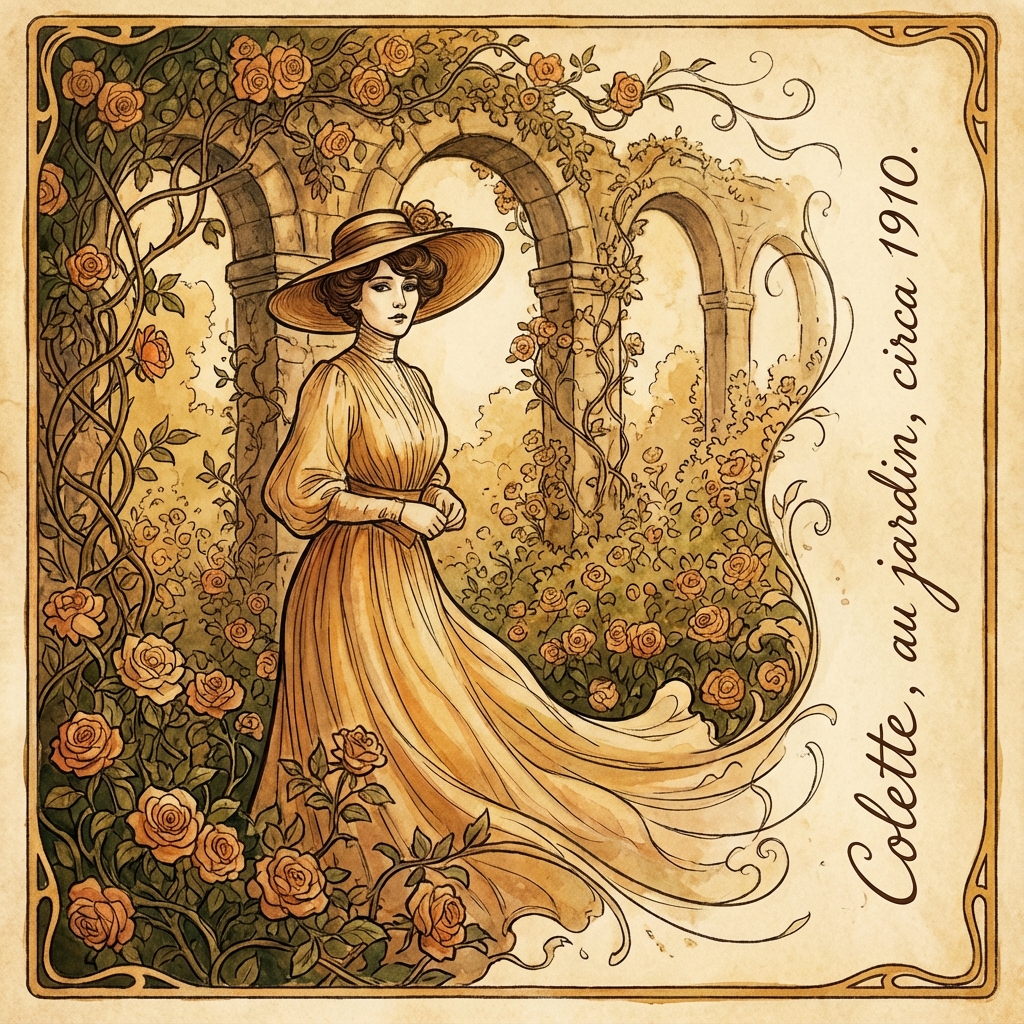
Sido / Les Vrilles de la vigne
"Look! The world is mine."
BIOGRAPHY: Colette (1873-1954)
📅 Essential Timeline
Burgundian Childhood (1873-1893)
- 1873: Born in Saint-Sauveur-en-Puisaye (Yonne).
- Sido: Her mother, Sidonie Landoy, is a radiant, loving, and free figure who transmits her love of nature.
- The Captain: Her father, Jules Colette, is a one-legged former military man, a dreamer and failed writer.
Apprenticeship and Emancipation (1893-1912)
- Willy: She marries Henry Gauthier-Villars (Willy) who takes her to Paris and exploits her by making her write the Claudine series under his name.
- The Music Hall: After her divorce (1906), she emancipates herself through scandal. She becomes a mime, a nude dancer, and lives sapphic loves (with Missy). This is the period of Les Vrilles de la vigne (1908).
Maturity and Glory (1912-1954)
- Recognition: She becomes a great novelist (Chéri, Le Blé en herbe) and journalist.
- Sido (1930): At 57 years old, at peace, she reflects on her childhood and pays homage to her mother.
- Honors: First woman president of the Académie Goncourt and first woman to receive a state funeral.
🎭 The Work and Its Context
A Temporal Diptych
The two works in the curriculum are separated by 20 years:
- Les Vrilles de la vigne (1908): The work of youth, the conquest of freedom and sensuality.
- Sido (1930): The work of maturity, the return to origins and the celebration of parental figures.
DETAILED SUMMARY
SIDO (1930)
This autobiographical narrative is divided into three parts, like a family triptych.
1. Sido (The Mother)
Colette paints a mythical portrait of her mother. Sido is the queen of the garden, a kind of pagan priestess who communicates with winds, plants, and animals. She teaches her daughter to "look" at the world ("Look!"). She embodies rootedness, vitality, and unconditional love.
2. The Captain (The Father)
A more melancholic figure. The Captain is an amputated man (physically and symbolically). He loves Sido with a mad love. He dreams of being a writer but leaves behind blank notebooks. Colette understands that she became a writer to fill her father's blank pages.
3. The Savages (The Siblings)
Colette evokes her half-brothers and her sister ("the stranger"). They are described as free beings, elusive, living on the margins of social conventions, like "wild ones".
LES VRILLES DE LA VIGNE (1908)
A collection of short texts (tales, prose poems, chronicles) very varied.
The Opening Tale (The Tendrils)
A nightingale nearly dies suffocated by the vine tendrils during its sleep. It wakes up in time and decides to sing all night to never let itself be trapped again. This is a metaphor for Colette who was nearly suffocated by her marriage to Willy and who chooses writing (song) to remain free.
Celebration of Body and Nature
In texts like Nuit blanche or Jour gris, Colette celebrates love (sometimes sapphic), the beauty of the female body, the sea, the forest. She claims a lucid hedonism: enjoying the world despite sadness.
Animal Dialogues
Toby-Chien and Kiki-la-Doucette (the cat) converse. Through them, Colette criticizes human customs and asserts the superiority of animal instinct.
GLOBAL ANALYSIS
📊 Overview
These two works illustrate the journey of a woman who constructs herself through the world and with the world. Colette doesn't think the world (like a philosopher), she tastes it. Her writing is a feast for the senses.
🎯 Essential Characteristics
Sensory Writing
Colette uses synesthesia (mixing of senses). She describes colors, smells, textures with botanical precision and poetic indulgence. The world is a matter to savor.
Animism
For Colette, everything is alive. Plants have a soul, animals speak, the wind has intentions. The human being is not superior to nature, he is part of it. This is a pantheistic vision.
Resurrection Through Words
To write is to conquer death. By meticulously describing the garden of her childhood or her mother's voice, she makes them eternal. Sido is a literary tomb more enduring than marble.
MAIN THEMES
🌿 Nature and the Cosmos
Nature is not a backdrop, it's a partner. Sido reads omens in the sky. Colette feels like "fruit", "plant", "animal". There is a total fusion between the subject and the cosmos.
🔓 Emancipation and Freedom
This is the central theme of Les Vrilles. Freedom has a price: solitude, anxiety (the nightingale no longer sleeps). But it is vital. Colette refuses constraints (marriage, bourgeois morality) to follow her instinct.
🕰️ Memory and Childhood
Childhood is a Lost Paradise. Saint-Sauveur is a Garden of Eden from which Colette was expelled. Writing is the only way to return. Memory is selective: it mythologizes the past to make it a golden legend.
👩 The Maternal Figure
Sido is omnipresent. She is the model of the free, curious, observant woman. She is also an overwhelming figure from whom one had to distance oneself to exist, before returning to her through writing.
ASSOCIATED THEME: The Celebration of the World
🎯 Theme Objective
This theme invites the study of how literature can say YES to the world, praise it, sing it, despite pain, old age, or death.
📚 Pedagogical Sequence
1. Celebrating Through the Senses (Hedonism)
Celebration in Colette is physical. It goes through the body. "The world is mine" means "I can touch it, smell it". It's a voracious appetite for life.
2. Celebrating to Save (Memory)
The world is ephemeral (flowers wilt, parents die). To celebrate is to fix the moment to prevent it from disappearing. It's a struggle against Time.
3. Celebrating Despite Everything (Lucidity)
Colette is not naive. She knows the cruelty of nature (the cat that kills the bird) and the pain of love. But she chooses to celebrate anyway. It's a conquered joy, a tragic wisdom (close to stoicism).
Theme Keywords
- Hymn: Song of praise.
- Epiphany: Moment of revelation of beauty.
- Transfiguration: The mundane becomes sacred through the gaze.
- Pantheism: God is in everything.
KEY QUOTATIONS
1. The Maternal Injunction
"Look! [...] See!"
- (Sido)
- Analysis: This is Sido's testament. Learning to see hidden beauty (a caterpillar, a drop of water) is the writer's first duty.
2. The Possession of the World
"The world is mine."
- (Les Vrilles de la vigne)
- Analysis: Affirmation of power. Not material possession (Colette is not rich), but sensory possession. He who knows how to enjoy the world is its king.
3. Freedom
"I want to do what I want [...] I want to sing, when it pleases me."
- (Les Vrilles de la vigne)
- Analysis: The credo of emancipation. The refusal of "tendrils" (the bonds that suffocate).
4. The Paternal Inheritance
"He had to be a poet, or I am nothing."
- (Sido)
- Analysis: Colette acknowledges that she writes in place of her father. She realizes the dream he couldn't accomplish.
ESSAY TOPICS
Topic 1: Celebration and Melancholy
"Does the celebration of the world in Sido and Les Vrilles de la vigne exclude sadness?"
Reflection Points
- A dominant joy: Wonder at nature, humor.
- An underlying melancholy: Mourning for childhood, the solitude of the free woman, the anxiety of time.
- Synthesis: Celebration is a victory over sadness. It's because the world will end that it is beautiful.
Topic 2: Autobiography
"Does Colette speak about herself or about others in these works?"
Reflection Points
- The detour through the other: She tells her story through the portrait of Sido, her father, her animals.
- The omnipresent Self: It's always her gaze, her memories. Others are mirrors of her identity.
- A relational identity: One doesn't exist alone, one is the fruit of one's connections (roots and tendrils).
Topic 3: Nature
"Is nature a refuge or a model for Colette?"
Reflection Points
- A refuge: Far from hypocritical Parisian society.
- A model: Nature teaches survival, instinct, beauty without artifice. Sido is "natural".
- A fusion: Colette doesn't distinguish herself from nature, she is a "beast" among beasts.
Express Quiz
Loading...
Session Complete!
Not bad!