AI MUSIC CREATION: THE NEW FRONTIERS OF SONIC ART
Explore the technological revolutions transforming musical composition, where artificial intelligence becomes a new creative collaborator for 21st-century musicians.
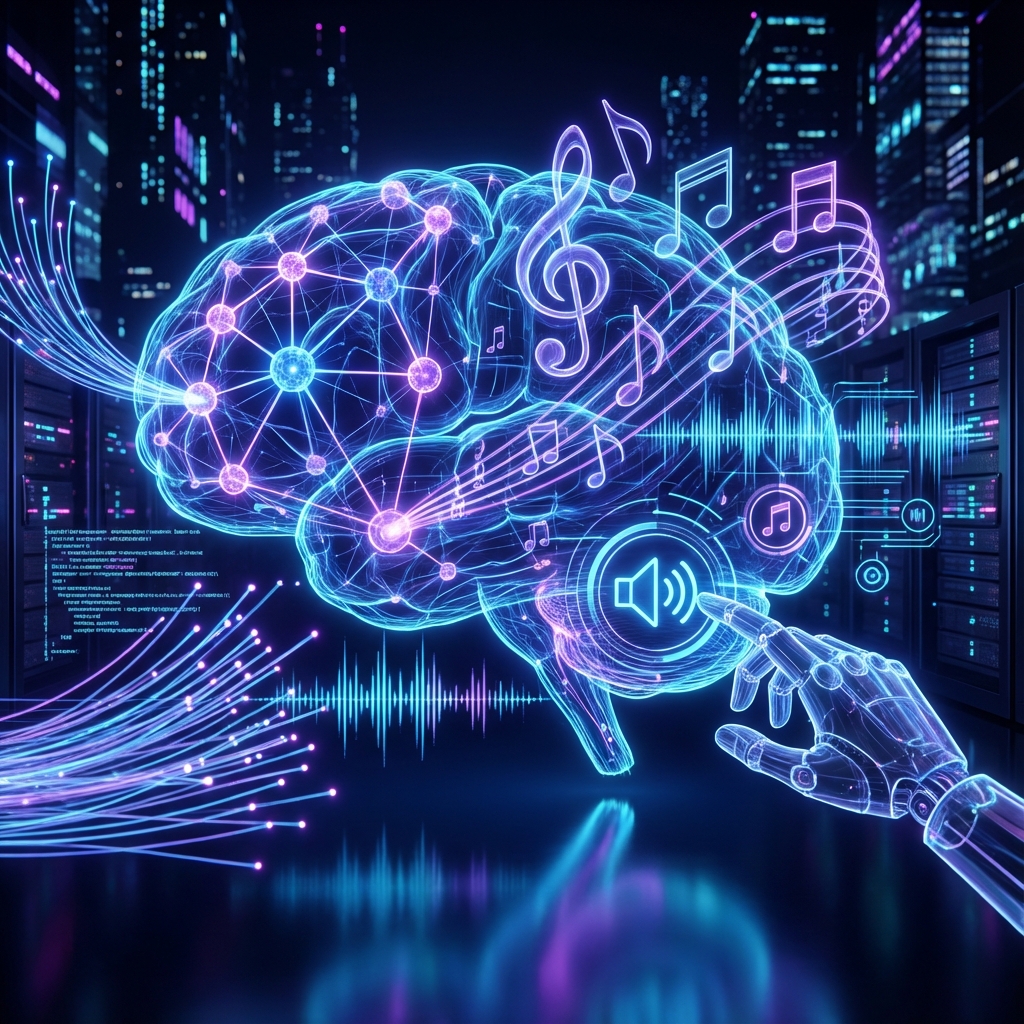
When Artificial Intelligence Composes
Artificial intelligence is revolutionizing musical creation by offering new tools for composition, arrangement, and production. Sophisticated algorithms can now analyze thousands of musical works, learn their structures, and generate new compositions in various styles. This technological revolution does not replace human creativity but augments and inspires it.
Contemporary composers explore these new possibilities to push the boundaries of their art, creating hybrid works where human intuition dialogues with artificial intelligence to give birth to unprecedented sounds.
Technologies and Approaches:
Machine Learning
- • Recurrent Neural Networks (RNN)
- • Musical Transformers
- • Reinforcement Learning
- • Melodic Pattern Analysis
Algorithmic Generation
- • Generative Adversarial Networks (GAN)
- • Musical Cellular Automata
- • Evolutionary Algorithms
- • Multi-Agent Systems
Popular Tools and Platforms:
- OpenAI MuseNet: Generation of compositions in different styles
- Google Magenta: Open-source tools for musical creativity
- AIVA (Artificial Intelligence Virtual Artist): AI composer for film music
- Amper Music: Automated music creation platform
- OpenAI Jukebox: Music generation with lyrics
- Flow Machines: Sony's composition assistance system
Creative Applications:
Assisted Composition
AI can suggest harmonies, generate thematic variations, or propose melodic developments, serving as a creative assistant to the composer.
Automatic Arrangement
Automatic transformation of a simple melody into a complete arrangement for different instrumental ensembles.
Interactive Personalization
Creation of adaptive music that evolves in real-time according to user interaction or listening context.
Issues and Perspectives:
AI music creation raises fascinating questions about the nature of creativity, artistic authenticity, and copyright. While some see it as a threat to traditional composers, others discover a tremendous tool for creative exploration that allows access to unexplored sonic territories.
Getting Started with AI Music
- • Experiment: Test free tools like Google Magenta Studio
- • Learn the basics: Understand the principles of musical machine learning
- • Collaborate: Use AI as a creative partner, not a replacement
- • Stay critical: Evaluate and refine generated results
- • Explore: Combine different approaches and technologies
The future of music is being shaped at the intersection of tradition and technological innovation. Artificial intelligence opens infinite creative possibilities, inviting musicians to rethink their art and explore new sonic horizons. This revolution is just beginning, and every composer can contribute by experimenting with these new tools.