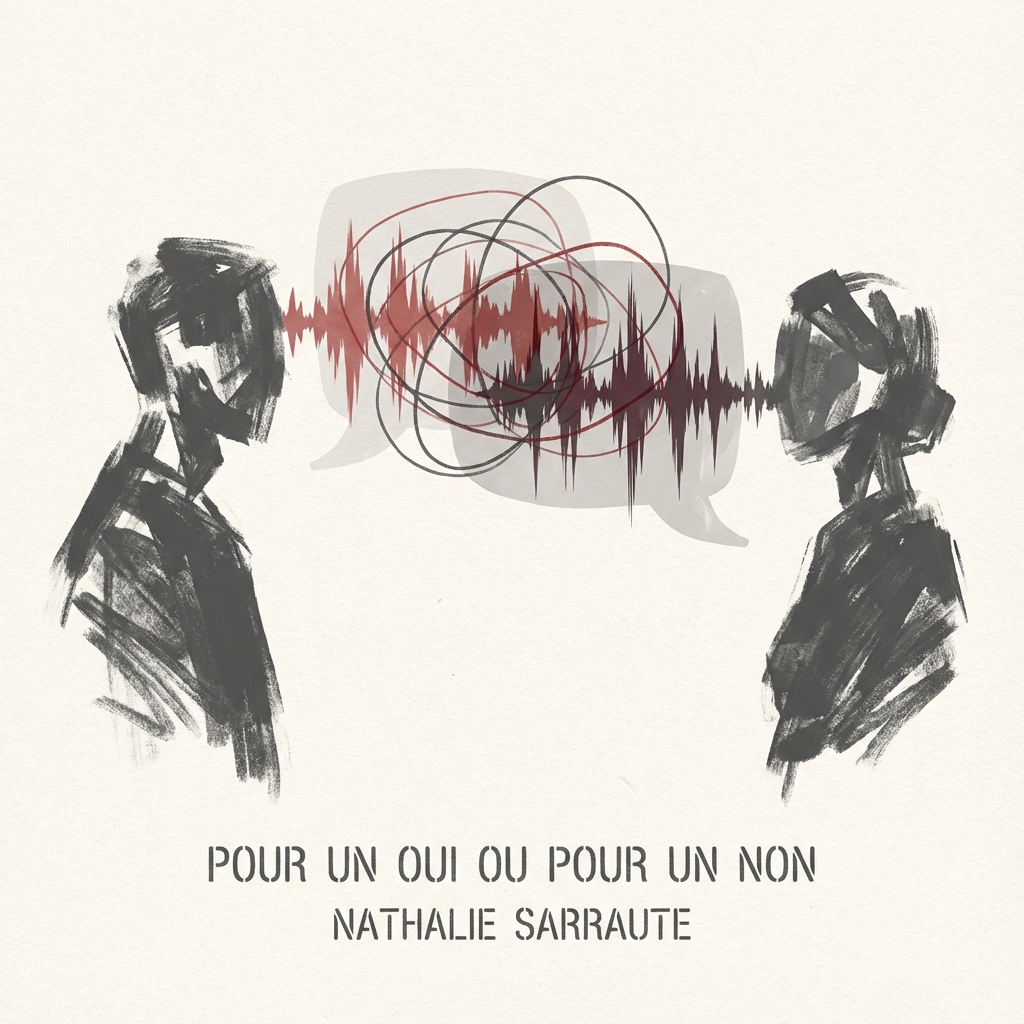
Pour un oui ou pour un non
"It's nice, that..." : when words become weapons.
BIOGRAPHY: Nathalie Sarraute (1900-1999)
📅 Essential Timeline
A Cosmopolitan Childhood
- 1900: Born in Russia (Ivanovo) into an intellectual Jewish family.
- Childhood: Divided between Russia, Switzerland, and France. She settled permanently in Paris at age 8. She became a lawyer.
Pioneer of the Nouveau Roman
- 1939: Publication of Tropismes. The work went unnoticed but laid the foundations for her entire aesthetic: the study of microscopic interior movements.
- 1956: L'Ère du soupçon (The Age of Suspicion). A major theoretical essay where she challenged traditional character and plot. She became a leading figure of the Nouveau Roman (alongside Robbe-Grillet, Butor, Simon).
Theater of the Voice
- 1960s-1980s: She turned to radio drama, then stage theater.
- 1982: Creation of Pour un oui ou pour un non. It was her greatest theatrical success.
- 1999: Died in Paris at 99, after publishing Ouvrez.
🎭 The Work and its Context
Theater of Silence
Sarraute doesn't write action theater. She writes what she calls "sub-conversation": what is felt but not said, or what is said to hide what is felt. It's a theater of listening and hypersensitivity.
DETAILED SUMMARY
A Structure Without Acts
The play is not divided into numbered acts or scenes. It's a continuous flow of dialogue between two men, H1 and H2.
1. The Spark: The "Nothing" That Is Everything
H1 visits H2, his longtime friend. A distance has developed. H2 finally confesses the cause of his withdrawal: a simple phrase uttered by H1 during a previous meeting.
H1 had said: "It's nice, that".
For H1, it was a harmless compliment. For H2, it's the intonation that matters: an infinitesimal pause, a drawn-out, condescending tone that meant "It's nice... for you." H2 felt judged, reduced, despised.
2. The Duel of Consciences
The dialogue becomes poisonous. H1 tries to rationalize ("You're crazy", "It's in your head"). H2 unfolds his hypersensitive vision of the world. He explains that this intonation revealed the gulf that separates them: H1 is a satisfied man, settled in conventional success, who looks down on H2 (the raw nerve, the failure perhaps).
It's the clash between two relationships to the world: reassuring rationality (H1) against anxious hypersensitivity (H2).
3. The Failure of Social Tribunal
To settle their dispute, they call upon neighbors (H3 and F). They try to replay the scene of "It's nice, that".
It's a total failure. The witnesses perceive nothing abnormal. They judge H2 "oversensitive" or "sick." Society (represented by the neighbors) refuses to see the underground violence of human relationships. It prefers the comfort of appearances. H2 finds himself alone with his truth.
4. The Impossible Break
Left alone, H1 and H2 go to the end of their confrontation. They understand they are incompatible. One lives in the safety of words, the other in the danger of sensations (tropisms).
They conclude: "It's hopeless".
Yet the play ends on a suspension. Can they part? No. They are bound by this very struggle. They need each other to define themselves. The break is pronounced ("For a yes or a no"), but the bond remains unbreakable.
GLOBAL ANALYSIS
📊 Overview
Pour un oui ou pour un non is a minimalist play that explodes theatrical conventions. No scenery, no names, no visible plot. Everything happens in the tiny gap between words and intonation.
🎯 Essential Characteristics
Tropisms
This is Sarraute's key concept. A tropism is an indefinable interior movement, rapid and violent, that precedes language. It's the physical sensation (discomfort, anger, fear) one feels in the presence of the other before speaking. The play attempts to put words to these mute sensations.
Sub-Conversation
There are two plays in one:
- The visible conversation: Polite words, banalities ("How are you?", "It's nice").
- The sub-conversation: The underground psychological war. This is where the real drama unfolds. Sarraute makes the invisible visible.
The New Theater
- Abstract characters: H1 and H2 are pure consciences, without identity or precise history.
- Microscopic action: The drama doesn't arise from murder or adultery, but from an intonation. It's the tragedy of everyday life.
MAIN THEMES
🗣️ Language: Weapon and Mask
Words are deceptive. Literal meaning (the dictionary) matters less than pragmatics (intonation, context). "It's nice, that" is a compliment on paper, but an insult in the voice. Language often serves to mask the violence of feelings.
🤝 Friendship and Otherness
Friendship is not a refuge here, but a place of danger. The friend is the one who knows us best, therefore the one who can hurt us most deeply. The play raises the question of equality: can we be friends if one feels judged by the other?
⚖️ Social Conformism
H1 embodies the norm, common sense, social success. H2 embodies marginality, anxiety, refusal of conventions. Society (the neighbors) rejects the one who scratches beneath the veneer (H2) and validates the one who stays on the surface (H1).
ASSOCIATED THEME: Theater and Dispute
🎯 Theme Objective
This theme invites reflection on dispute as the driving force of theatrical action. Dispute is not just conflict, it's a moment of truth when masks fall.
📚 Pedagogical Sequence
1. Dispute Over Nothing?
The reason for the dispute seems futile ("for a yes or a no"). But as with Marivaux or Molière, the pretext hides a vital stake. Here, it's H2's dignity that's at stake.
2. Speech as Action
In this theater, speaking is acting. Saying "You hurt me" is attacking. Being silent is defending oneself. The dispute is a verbal boxing match where each line is a blow.
3. The Impossible Reconciliation
The dispute reveals a fundamental incompatibility. Unlike classical comedy which ends in marriage or reconciliation, here the conflict has no resolution (aporia). It's the mark of modern theater (Beckett, Ionesco).
Theme Keywords
- Stichomythia: Rapid exchange of short lines (verbal ping-pong).
- The Unsaid: What weighs on the dialogue.
- Crisis: Moment of rupture in equilibrium.
KEY QUOTATIONS
1. The Trigger
"It's niiice... that..."
- (H1 quoted by H2)
- Analysis: Everything is in the lengthening of the vowel and the detachment of "that". It's proof that intonation carries meaning, far more than words.
2. The Unspeakable
"It's nothing. Nothing one can speak about."
- (H2)
- Analysis: H2 knows that if he names his discomfort, he'll appear ridiculous. Tropisms are pre-verbal sensations that die when put into words.
3. Relational Paranoia
"You were watching me from the corner of your eye, ready to pounce..."
- (H2 to H1)
- Analysis: Friendship is experienced as mutual surveillance. It's the Sartrean vision: "Hell is other people".
4. The Admission of Failure
"It's hopeless."
- (H1 and H2)
- Analysis: Final lucidity. They can neither understand each other nor leave each other. They are condemned to be together in incomprehension.
ESSAY TOPICS
Topic 1: Speech
"In Pour un oui ou pour un non, does speech serve to communicate or to confront?"
Reflection Points
- Communication failure: Words don't tell the truth (misunderstandings).
- Weapon of war: Irony, innuendo, silence are weapons.
- Revelation: It's paradoxically in confrontation that the truth of the relationship appears.
Topic 2: The Tragedy of Everyday Life
"Can there be tragedy without great events?"
Reflection Points
- Refusal of the spectacular: No blood, no physical death.
- Inner violence: H2's suffering is real and absolute. It's a social or psychic death.
- Universality: Everyone has experienced this kind of discomfort. It's a tragedy of proximity.
Topic 3: Friendship
"Is friendship presented as a positive value in the play?"
Reflection Points
- A pessimistic vision: Friendship is a place of struggle and domination.
- A demand for authenticity: H2 breaks because he has too high an idea of friendship (he wants total transparency).
- The unbreakable bond: Despite everything, they don't separate. It's a form of love-hate.
Express Quiz
Loading...
Session Complete!
Not bad!