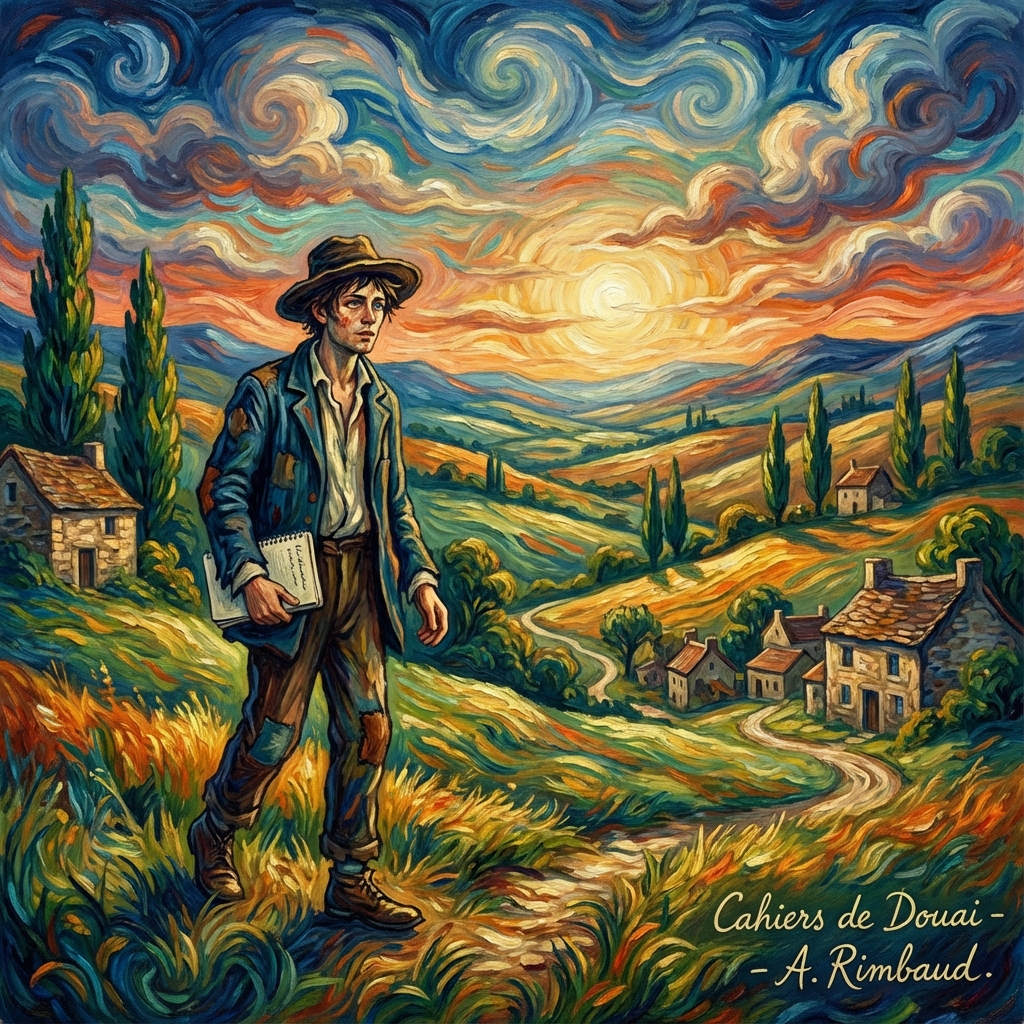
Cahiers de Douai
"I walked on, my fists in my torn pockets..."
BIOGRAPHY: Arthur Rimbaud (1854-1891)
📅 Essential Timeline
The Rebellious Adolescent (1854-1870)
- 1854: Born in Charleville (Ardennes). Absent father, authoritarian mother ("Mother Rimb").
- 1870: Brilliant student who won numerous prizes. But he felt stifled in the provinces. Encouraged by his teacher Georges Izambard, he began to write and ran away several times to Paris and Belgium.
The Poetic Lightning (1870-1875)
- 1870: Writing of the 22 poems of the Cahiers de Douai during his stays at Izambard's aunts' house in Douai.
- 1871: Letter of the Seer ("I is another"). Meeting with Verlaine in Paris. Beginning of a bohemian and scandalous life.
- 1873: Brussels drama (Verlaine shoots Rimbaud). Publication of A Season in Hell.
- 1875: At 21, he definitively renounces poetry.
The Man with Wandering Soles (1875-1891)
- Travels: He traveled across Europe, then left for Africa (Ethiopia, Yemen).
- Trade: He became a merchant, arms dealer.
- 1891: Return to France for a knee tumor. Amputated, he died in Marseille at age 37.
🎭 The Work and its Context
Cahiers de Douai (1870)
This collection (posthumous title) brings together the early poems entrusted to Paul Demeny. It testifies to the lightning transition between a talented young Parnassian poet and the visionary genius who would revolutionize modern poetry.
DETAILED SUMMARY
Structure of the Collection
The collection was not organized by Rimbaud for publication, but it groups together two bundles of poems written in spring and autumn 1870. Several veins of inspiration can be distinguished.
1. The Satirical and Political Vein
Rimbaud settles accounts with bourgeois society and the Second Empire.
- "À la musique": Fierce satire of the bourgeois of Charleville listening to the military orchestra.
- "Rage de Césars", "L'Éclatante Victoire de Sarrebrück": Violent attacks against Napoleon III.
- "Le Mal": Denunciation of war and the indifference of God and kings.
2. The Sensual and Amorous Vein
The adolescent expresses his first emotions, often in a light and ironic tone.
- "Première Soirée": Daring intimate scene ("She was quite undressed...").
- "Les Reparties de Nina": Invitation to amorous and bucolic journey.
- "Roman": "You're not serious when you're seventeen". The carefree nature of youthful loves.
3. The Wandering and Nature Vein
This is the most famous part, that of joyful vagabondage.
- "Sensation": Sensual fusion with Nature ("I'll go far, very far...").
- "Ma Bohème": The celestial vagabond poet, transforming his misery into poetic gold.
- "Au Cabaret-Vert": Simple pleasures of the stop (bread and butter with ham).
4. The Visionary and Symbolist Vein
Rimbaud surpasses realism to reach a mythical dimension.
- "Le Dormeur du val": Realistic tableau that reveals itself to be a tragic denunciation of death.
- "Ophélie": Rereading of the Shakespearean myth, symbol of the misunderstood Poet.
GLOBAL ANALYSIS
📊 Overview
The Cahiers de Douai are the work of a 16-year-old genius in full transformation. We see Rimbaud imitating his masters (Hugo, Banville, Baudelaire) to better surpass them and find his own voice, that of absolute revolt and freedom.
🎯 Essential Characteristics
Multifaceted Revolt
- Political revolt: Against the Empire, war, the established order.
- Social revolt: Against the bourgeois ("Les Assis"), conformism, religion.
- Poetic revolt: Against the strict rules of Parnassus. He dislocates the alexandrine (bold enjambments, expressive rejets) and introduces prosaic or slang language into poetry.
Creative Emancipation
The collection traces the journey of liberation. Rimbaud emancipates himself from his mother, his town, his teachers, and finally from literary models. He invents a poetry of movement, of immediate sensation, where "I" is another, a seer who deciphers the world.
MAIN THEMES
🚶 Wandering and Freedom
Walking is the engine of writing. Rimbaud is a "pedestrian" (Ma Bohème). Freedom is physical (running away), moral (refusal of codes) and poetic (liberated verse). Nature is the maternal and sensual refuge of the vagabond.
🔥 Youth and the Body
This is a collection about adolescence: hunger, thirst, sexual desire, intoxication. The body is omnipresent, whether glorious (Sensation), comic (Vénus Anadyomène) or tragic (Le Dormeur du val).
⚔️ War and History
Written during the 1870 war, the poems bear witness to the trauma. But Rimbaud does not write patriotic poetry: he denounces the absurdity of massacre ("Le Mal") and mocks the leaders.
🎭 Satire of the Bourgeoisie
Rimbaud hates provincial mediocrity. He caricatures notables, librarians, customs officers with fierce and jubilant verve. It's the destructive laughter of the anarchist.
ASSOCIATED THEME: Creative Emancipations
🎯 Theme Objective
This theme invites us to study how poetic creation allows Rimbaud to emancipate himself, that is, to free himself from all tutelage (familial, social, literary) to invent a new way of being in the world.
📚 Pedagogical Sequence
1. Emancipating from Models
Rimbaud begins by pastiching (Hugo, the Parnassians) but he subverts their codes. In Vénus Anadyomène, he parodies the birth of Venus by describing an ugly woman emerging from a bathtub. He breaks the classical ideal of Beauty.
2. Emancipating through Flight
The poems of wandering (Sensation, Ma Bohème) show that poetry is born from displacement. Leaving the place of origin is finding one's voice. "I'll go far...".
3. Emancipating through Language
Rimbaud liberates verse. He uses trivial words ("buttocks", "beer", "piss"), broken rhythms. He proves that poetry can say everything, even the ugly, even the banal, and transform it into gold.
Theme Keywords
- Flight: Geographic and poetic escape.
- Derangement: Will to change perception (Letter of the Seer).
- Modernity: Refusal of the past, adherence to the present.
- Alchemy: Transforming mud into gold.
KEY QUOTATIONS
1. Sensual Freedom
"Par les soirs bleus d'été, j'irai dans les sentiers,
Picoté par les blés, fouler l'herbe menue"
(English: "On blue summer evenings, I'll go along the paths,
Pricked by the wheat, treading the fine grass")
- (Sensation)
- Analysis: The call of nature and freedom. Total fusion of the senses (sight, touch).
2. Adolescence
"On n'est pas sérieux, quand on a dix-sept ans."
(English: "You're not serious when you're seventeen.")
- (Roman)
- Analysis: The motto of youth. Carefreeness, lightness, but also lucidity about the passage of time.
3. The Poetry of Wandering
"Petit-Poucet rêveur, j'égrenais dans ma course
Des rimes. Mon auberge était à la Grande-Ourse."
(English: "Dreamy Tom Thumb, I scattered along my way
Rhymes. My inn was at the Great Bear.")
- (Ma Bohème)
- Analysis: The cosmic vagabond poet. Material misery is transfigured by poetic imagination.
4. Denunciation of War
"Il dort dans le soleil, la main sur sa poitrine
Tranquille. Il a deux trous rouges au côté droit."
(English: "He sleeps in the sun, hand on his chest
Peacefully. He has two red holes in his right side.")
- (Le Dormeur du val)
- Analysis: The brutal ending. The contrast between the serenity of nature and the violence of human death.
ESSAY TOPICS
Topic 1: Emancipation
"How are the Cahiers de Douai the story of an emancipation?"
Reflection Points
- Social emancipation: Flight from family, critique of bourgeoisie.
- Poetic emancipation: Break with classical rules, invention of a language.
- Sensory emancipation: Discovery of the body, nature, freedom.
Topic 2: Nature
"What place does nature occupy in this collection?"
Reflection Points
- Maternal refuge: It consoles, it cradles ("Nature, rock him warmly").
- Space of freedom: Place of wandering and adventure.
- Mirror of the soul: It reflects the poet's moods (melancholy or joy).
Topic 3: Tradition and Modernity
"Rimbaud in the Cahiers de Douai: heir or revolutionary?"
Reflection Points
- Heir: Use of sonnet, alexandrine, romantic themes (nature, love).
- Revolutionary: Ironic treatment, verse dislocation, trivial vocabulary.
- Synthesis: He uses old forms to say new things.
Express Quiz
Loading...
Quiz Complete!
Not bad!