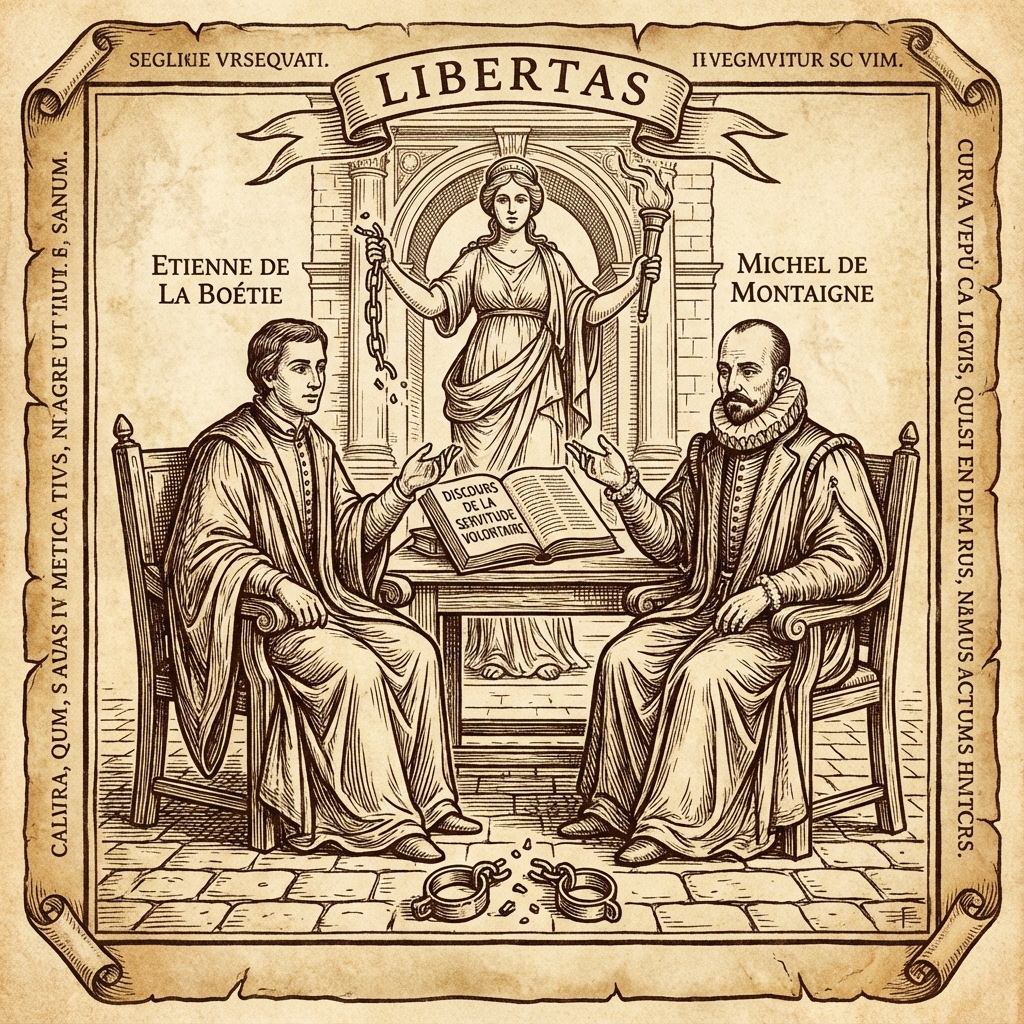
Discours de la servitude volontaire
BIOGRAPHY: Étienne de La Boétie (1530-1563)
📅 Essential Timeline
Youth and Education
- 1530: Born in Sarlat (Périgord) into a wealthy family of magistrates. He lost his father at a very young age and was raised by his uncle, a scholarly priest.
- Studies: He received an excellent humanist education. He studied law at the University of Orléans, a Protestant and critical intellectual center. It was probably around age 18 (according to Montaigne) that he wrote the Discours de la servitude volontaire.
The Magistrate Career
- 1553: He obtained his position as councilor in the Parliament of Bordeaux (before the legal age, thanks to a special dispensation).
- The Legendary Friendship: It was in Parliament that he met Michel de Montaigne in 1557. Their instant friendship ("Because it was him, because it was me") would last until La Boétie's death.
A Premature Death
- 1563: He died suddenly, probably from plague or dysentery, at the age of 32. Montaigne assisted him in his agony and remained inconsolable.
🎯 The Work and Its Context
The Crisis Context
- Wars of Religion: La Boétie lived in a time troubled by conflicts between Catholics and Protestants. As a magistrate, he defended a policy of reconciliation (Edict of January 1562) but remained faithful to Catholicism and royal order, condemning seditions (which paradoxically contrasts with the radicalism of his Discourse).
The "Contr'Un"
The Discours de la servitude volontaire (or Contr'Un) is his major work. It is a brilliant rhetorical exercise that poses a fundamental political question: why do we obey?
The Humanist
La Boétie was also a poet (love sonnets) and a translator of Greek authors (Xenophon, Plutarch). He embodied the humanist ideal: classical culture, moral demand, virtuous friendship.
🏛️ Reception and Legacy
Posthumous Publication
Montaigne would not dare publish the Discourse at first, fearing it would be used by Protestants as an anti-monarchical pamphlet. It was published in full in 1576.
Political Impact
The text has been appropriated in all eras: by Revolutionaries in 1789, by the Resistance in 1940, and by civil disobedience movements today. Its central idea (power comes from the consent of the governed) is the basis of modern political philosophy.
DETAILED SUMMARY
I. The Paradox of Servitude (The Exordium)
The text opens with a quote from Homer (Ulysses) saying that it is not good to have several masters. La Boétie goes further: it is not good to have any master at all.
He then poses the central problem: how is it that thousands of men, entire cities, submit to a single tyrant?
- This tyrant is nevertheless only a man ("he has only two eyes, two hands...").
- He has only the power that we give him.
- If it were through fear or force (war), it would be understandable. But here, the disproportion is such (one against a million) that it can only be through consent. It is a nameless vice: voluntary servitude.
The solution is simple: to overthrow the tyrant, there is no need to kill him. It is enough to no longer serve him. "Be resolved not to serve anymore, and there you are free."
II. The Origin of Servitude (The Causes)
La Boétie seeks to understand how man could have forgotten his original freedom.
1. Nature and Liberty
Man is naturally free. Freedom is a natural right. Even animals refuse captivity (the elephant, the horse). The man who serves has therefore "denatured" his condition.
2. Custom (First Cause)
The first reason for servitude is habit.
- The first generation serves by constraint (conquest).
- The second generation serves by habit ("without regret"). They take as natural the state in which they were born.
- Example of horses: the horse trained from birth bites the bit without complaining.
- Only a cultured elite ("the best-born") can remember freedom through study and reason.
3. The Tools of Tyranny (Second Cause)
To maintain the people (the "common folk") in servitude, the tyrant uses tricks:
- Distractions: Games, feasts, brothels ("drugs", "panem et circenses"). The people become dulled in easy pleasure.
- Religion: Tyrants surround themselves with mystery, claim to be sent by the gods, perform miracles to impress the superstitious crowd.
III. The Secret of Domination (The Pyramid)
This is the most original point of the analysis. The tyrant does not hold alone, nor by his army. He holds through a chain of complicity.
- The Tyrant has 5 or 6 favorites (accomplices) who profit from him.
- These 6 have 600 men under their command whom they corrupt.
- These 600 hold 6000 through positions (government, finance).
- In the end, millions of people have an interest in tyranny ("The tyrant's rope").
IV. The Tyrant's Misery (Peroration)
La Boétie concludes by pitying the tyrant and his courtiers.
- The courtier is more enslaved than the people: he must not only obey, but guess the master's desires and anticipate his whims. He lives in constant fear.
- The tyrant can never be loved nor love. Friendship can only exist between good and equal people. The tyrant is alone, surrounded by treacherous flatterers.
- The final appeal: Let us raise our eyes to heaven and to God, guardian of justice, who will punish tyrants.
GLOBAL ANALYSIS
📊 Overview
Written around 1548 (by an 18-year-old young man) and published in full in 1576 (under the title Le Contr'Un in a Protestant collection), this text is a literary UFO. It is neither a classical political treatise nor a simple academic dissertation, but a virulent and eloquent charge against tyranny.
🎯 Essential Characteristics
The Project: A Political Enigma
La Boétie does not attack a particular tyrant (he does not cite the King of France). He attacks the very principle of domination. He poses an anthropological question: how is it possible that millions of men accept to submit to a single one, who has only the power we give him?
Structure of the Discourse
The text follows a rigorous logical progression (judicial rhetoric):
- Exordium (Introduction): The astounding observation. A single man enslaves a multitude. It is not through cowardice (they are too numerous), it is therefore through consent. The name of the evil is "voluntary servitude".
- Confirmation (Analysis of Causes): Why does man, born free, accept chains? (Custom, Trickery, Tyrannical Chain).
- Peroration (Conclusion): Appeal to prayer and virtue. The tyrant is a colossus with feet of clay.
The Registers
- Didactic: La Boétie wants to teach freedom.
- Polemical: He violently attacks the "favorites" and courtiers.
- Oratorical/Pathetic: He addresses the people ("Poor and miserable senseless peoples!").
MAIN THEMES
1. Natural Liberty
This is the starting postulate.
- Innateness: Man is born free. Freedom is not a social privilege, it is a biological and moral characteristic of the human species (as with animals).
- Brotherhood: Nature made all men "of the same form" so they would recognize each other as brothers, not so the strong would enslave the weak.
2. Consent (Voluntary Servitude)
This is the revolutionary concept of the book.
- The paradox: The victim is complicit with their executioner. It is the people who "offer their throat" to the knife.
- Alienation: Man loses his own essence by serving another. He becomes a thing, a tool of the tyrant.
3. Custom (Habit)
This is the sociological explanation of submission.
- Forgetting: Over time, man forgets he was free. He takes his slave condition as a natural state.
- Education: Children are educated to obey ("the bit in their mouth"), which prevents them from conceiving another life.
4. Tyranny and the Pyramid
La Boétie analyzes the mechanics of power.
- The One: The tyrant is alone ("The Contr'Un"). This solitude is his weakness.
- The chain: Power trickles down from top to bottom through self-interest. Everyone accepts being the slave of the superior to be the tyrant of the inferior. It is generalized corruption.
5. Friendship
This is the political counter-model.
- Equality: Friendship can only exist between equals.
- Virtue: It is based on mutual esteem, not on interest.
- Incompatibility: There is no possible friendship with a tyrant, nor among the accomplices of a tyrant (it is only "conspiracy").
ASSOCIATED THEME: The Rhetoric of Combat and Liberty
🎯 Theme Objective
This theme (often titled "Writing and Fighting" or "Political Speech") focuses on how literature becomes a weapon to defend ideas. It is about seeing how the art of speaking well (rhetoric) is put in service of a cause: freedom.
📚 Educational Sequence
1. A Weapon Against Tyranny (The Pamphlet)
The Discourse is not a cold analysis, it is a combat text.
- Direct Address: La Boétie addresses the reader directly ("Poor and miserable people..."). He wants to shake consciences, provoke a reaction.
- Indignation: The engine of the text is anger at injustice and human stupidity. It is an "eloquence of the tribune".
2. Deconstructing Political Myths
Fighting also means demystifying. La Boétie attacks the symbolic foundations of power:
- He shows that the King is naked (he is a "little man", often cowardly and weak).
- He denounces the religious use of power (miracles, lilies, banners) as propaganda tools to deceive the naive.
3. Performative Speech
The text illustrates the power of words.
- The tyrant reigns through the silence he imposes.
- La Boétie's speech aims to break this silence. Speaking the truth ("The king is a tyrant", "You are accomplices") is already beginning to free oneself. The text does not propose taking up arms, but speaking up (refusing to consent).
Theme Keywords
- Eloquence: The art of persuading and moving.
- Pamphlet: Brief and violent writing against someone or something.
- Indictment: Methodical accusation (against the tyrant and against the people).
- Plea: Defense of a cause (natural freedom).
- Humanism: The fight for human dignity.
KEY QUOTATIONS
On the Paradox of Servitude
"For this occasion, I would only like to understand how it can be that so many men, so many towns, so many cities, so many nations sometimes endure a single tyrant, who has only the power they give him."
- Comment: This is the central problem. The tyrant's power does not come from his own strength, but from the credit the people grant him.
"So it is the peoples themselves who let themselves, or rather make themselves be dominated, since by ceasing to serve they would be free of it."
- Comment: Reversal of responsibility. The victim is complicit. The verb "make themselves be dominated" emphasizes the active passivity of the people.
The Solution: Refusal to Serve
"Be resolved not to serve anymore, and there you are free."
- Comment: The most famous formula. Freedom is not acquired through arms, but through an act of negative will (refusal). It is the principle of civil disobedience.
"I do not want you to push him or shake him, but simply no longer support him, and you will see him, like a great colossus from which its base has been stolen, fall down by its own weight and break."
- Comment: Image of the Colossus with feet of clay. Political power is an optical illusion; it collapses as soon as we stop believing in it.
On Custom and Nature
"The nature of man is indeed to be free and to want to be so, but also his nature is such that naturally he takes the fold that upbringing gives him."
- Comment: Distinction between innate (freedom) and acquired (servitude). Education ("upbringing") and habit ("fold") can denature man and make him love his chains.
ESSAY TOPICS
Topic 1: The Responsibility of the People
Topic: "In the Discours de la servitude volontaire, La Boétie states: 'It is the peoples themselves who let themselves, or rather make themselves be dominated'. How does this sentence summarize the originality of his political analysis?"
Reflection Points
- The reversal of perspective: Usually, we blame the wicked tyrant who oppresses the good people. La Boétie blames the victim. The tyrant is nothing without the people.
- Servitude as activity: The expression "make themselves be dominated" shows that servitude is not a passive state endured, but a continuous action of submission (paying taxes, obeying orders).
- The liberating scope: If the people are responsible, then the people have power. It depends only on them to change the situation. It is a paradoxical message of hope.
Topic 2: The Role of Speech
Topic: "Can we say that the Discours de la servitude volontaire is a combat text?"
Reflection Points
- A warlike style: Analysis of the polemical register, direct addresses, violent rhetorical questions. La Boétie wants to shame his readers to awaken them.
- The weapon of reason: The combat is not physical, it is intellectual. It is about fighting ignorance and habit through logic and history.
- The limits of combat: La Boétie does not advocate tyrannicide (killing the king). His combat is ethical and philosophical. It is peaceful resistance before its time.
Topic 3: Friendship and Tyranny
Topic: "What role does the concept of friendship play in La Boétie's critique of tyranny?"
Reflection Points
- The fundamental antithesis: Tyranny is the reign of solitude and mistrust. The republic (or free society) is the reign of friendship and trust.
- The critique of conspiracy: The tyrant's "friends" are only accomplices. They are bound by crime, not by affection.
- Friendship as political model: For La Boétie, a just society is a society of friends, that is, equal and free men who help each other.
Express Quiz
Loading...
Session Complete!
Not bad!