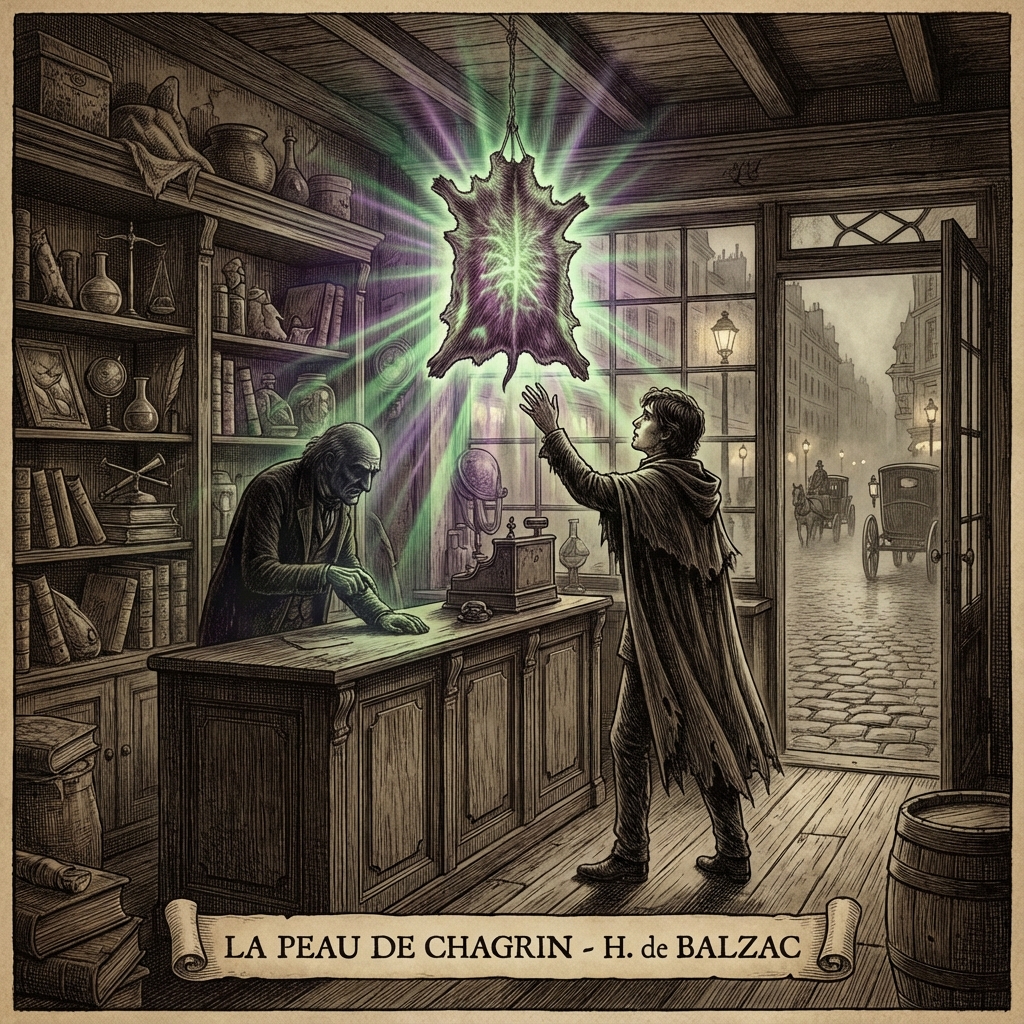
La Peau de chagrin
"With each desire, I shall shrink like your days."
BIOGRAPHY: Honoré de Balzac (1799-1850)
📅 Essential Chronology
The Literary Galley Slave
- 1799: Born in Tours. Solitary childhood (boarding school).
- 1820-1829: Years of struggle in Paris. He writes pulp novels under pseudonyms and goes bankrupt as a printer. He will carry debts all his life.
- 1829: First success with Les Chouans.
La Comédie Humaine (1830-1850)
- 1831: Publication of La Peau de chagrin. He achieves fame.
- The Project: He conceives La Comédie Humaine, a gigantic fresco (90 novels) to describe all the society of his time ("to compete with the civil registry"). He writes at night, fueled by coffee.
- 1850: Exhausted by work, he marries his great love, Madame Hanska, and dies a few months later at age 51.
🎭 The Work and its Context
A Visionary Novel
La Peau de chagrin is classified in the "Philosophical Studies." It is a pivotal work that mixes realism (precise description of Paris in 1830) and the fantastic (the talisman). Balzac exposes his theory of vital energy.
DETAILED SUMMARY
I. The Talisman
Paris, October 1830. Raphaël de Valentin, a ruined and desperate young man, enters a gaming house, loses his last coin and decides to commit suicide in the Seine at nightfall.
While waiting, he wanders into an antique dealer's shop. The old man offers him a talisman: a wild ass skin (shagreen) with an inscription in Sanskrit. It grants all wishes, but shrinks with each desire, taking away the owner's life.
Raphaël accepts the pact defiantly ("I want to live with excess"). He wishes for a royal feast. Immediately, he is invited to an orgy at banker Taillefer's house.
II. The Woman Without a Heart
During the orgy, Raphaël tells his life story to his friend Émile (flashback).
He lived poorly in an attic, working on his "Theory of the Will," supported by Pauline, his landlady's daughter, who secretly loved him.
But he dreamed of glory and luxury. He fell in love with Countess Fœdora, a rich, beautiful but cold woman ("the woman without a heart"). He ruined himself trying to seduce her, in vain. Humiliated and indebted, he ended up wanting to die. This is what led him to the antique dealer.
III. The Agony
Return to the present. Raphaël has become rich (wished-for inheritance), but the Skin has shrunk. Terrified of death, he isolates himself in a private mansion, organizing his life to have no desires.
He sees Pauline again, who has also become rich. They love each other. But this love (a violent desire) makes the Skin shrink dangerously.
Raphaël consults scholars to stretch the Skin: failure. He flees to Aix-les-Bains, then to Auvergne, but he spreads death around him.
He returns to die in Paris. In a final scene of horror and passion, he throws himself on Pauline and dies trying to devour her with kisses, the Skin disappearing in his hand.
GLOBAL ANALYSIS
📊 Overview
This novel is a philosophical fable about desire and death. Balzac poses a terrible equation: Desire = Power = Destruction. All intensity of life is paid for by accelerated wear.
🎯 Essential Characteristics
Realistic Fantasy
The supernatural (the Skin) is not there to frighten, but to make visible an invisible law: life is a limited capital of energy. The novel is anchored in reality (Paris, 1830, money, politics) but the talisman gives it a metaphysical dimension.
Social Criticism
Balzac paints the Paris of the July Monarchy, dominated by money and pleasure. Fœdora embodies this brilliant but sterile society. The orgy at Taillefer's shows a disillusioned youth that no longer believes in anything.
MAIN THEMES
⚡ Vital Energy
This is the central theme. Man has a finite dose of energy. He has the choice between:
- Desire and Power (Raphaël): Intensity, passion, but rapid death.
- Knowledge (The Antique Dealer): Calm, study, longevity, but without emotion.
💰 Money and Society
Everything can be bought in this world. Raphaël buys Fœdora's love (or tries to). The Skin itself is a metaphor for money that slips through one's fingers. Society is a machine for crushing individuals through luxury and vanity.
💔 Destructive Desire
Desire is not a positive force here. It is a disease, a burning. "La Peau de chagrin" is the mirror of our frantic consumption. The more we possess, the more we empty ourselves.
👩 Woman: Angel or Demon
- Fœdora: The social woman, artificial, cold. She takes others' energy without giving anything.
- Pauline: The natural woman, maternal, loving. She gives everything. But even her love becomes deadly for Raphaël because it arouses desire.
ASSOCIATED THEME: Novels of Energy: Creation and Destruction
🎯 Theme Objective
This theme explores the dynamics of the novelistic hero in the 19th century. The hero is a force in motion, driven by creative energy (ambition, love, work) that ends up destroying him.
📚 Pedagogical Sequence
1. Creative Energy
Raphaël is a creator. He writes ("Theory of the Will"), he invents his life, he wants to conquer the world. This energy is fascinating, it is that of youth and progress.
2. Inevitable Destruction
The novel shows the dark side. To create is to burn. The shrinking Skin is the perfect image of entropy (loss of energy). Balzac shows that all social or artistic success is paid for with one's life.
3. The Artist's Paradox
Balzac himself is Raphaël. He worked himself to death to create La Comédie Humaine. The novel is an allegory of the writer's condition: he transforms his life (the Skin) into ink (the Work).
Theme Keywords
- Ambition: Social engine of the 19th century.
- Wear: Physical consequence of passion.
- Faustian: Pact with the devil (or destiny) to have power.
- Vitalism: Cult of intense life.
KEY QUOTATIONS
1. The Pact
"À chaque vouloir, je décroîtrai comme tes jours. Me veux-tu ? Prends. Dieu t'exaucera. Soit !"
("With each desire, I shall shrink like your days. Do you want me? Take me. God will grant your wishes. So be it!")
- (Inscription on the Skin)
- Analysis: The rule of the game is set. The link is direct between desire (to want) and death (to shrink).
2. The Choice of Intensity
"Je veux vivre avec excès."
("I want to live with excess.")
- (Raphaël)
- Analysis: This is the cry of the romantic hero. He refuses the mediocrity and prudence of the antique dealer. He prefers the quality of life to its duration.
3. The Woman Without a Heart
"Fœdora n'a pas de cœur, elle a une tête."
("Fœdora has no heart, she has a head.")
- (Raphaël)
- Analysis: Fœdora is a monster of coldness. She calculates everything. She is the allegory of selfish Parisian society.
4. The Law of Energy
"L'homme s'épuise par deux actes [...] : Vouloir et Pouvoir."
("Man exhausts himself through two acts [...]: Desire and Power.")
- (The Antique Dealer)
- Analysis: The Balzacian theory. Desire and action are the two vampires of life.
ESSAY TOPICS
Topic 1: Desire
"Is desire presented as a life force or a death force in the novel?"
Reflection Points
- Life force: It pushes to act, to love, to rise. Without desire, Raphaël is a vegetable.
- Death force: It consumes vital capital (the Skin). It leads to madness and agony.
- Synthesis: It is a tragic force. It is necessary but fatal.
Topic 2: The Fantastic
"How does the fantastic enable a realistic depiction of society?"
Reflection Points
- The detour: The talisman allows materialization of abstract ideas (time, money).
- The truth: It reveals the hidden truth of beings (selfishness, thirst for gold).
- Amplification: It gives a mythical dimension to everyday dramas of ambition.
Topic 3: The Artist
"Is Raphaël de Valentin a figure of the artist?"
Reflection Points
- Creation: He is a writer, he has a vision of the world.
- Sensitivity: He perceives things more intensely than others.
- Sacrifice: Like the artist, he sacrifices his life for his ideal (or his desires).
Express Quiz
Loading...
Session Complete!
Not bad!