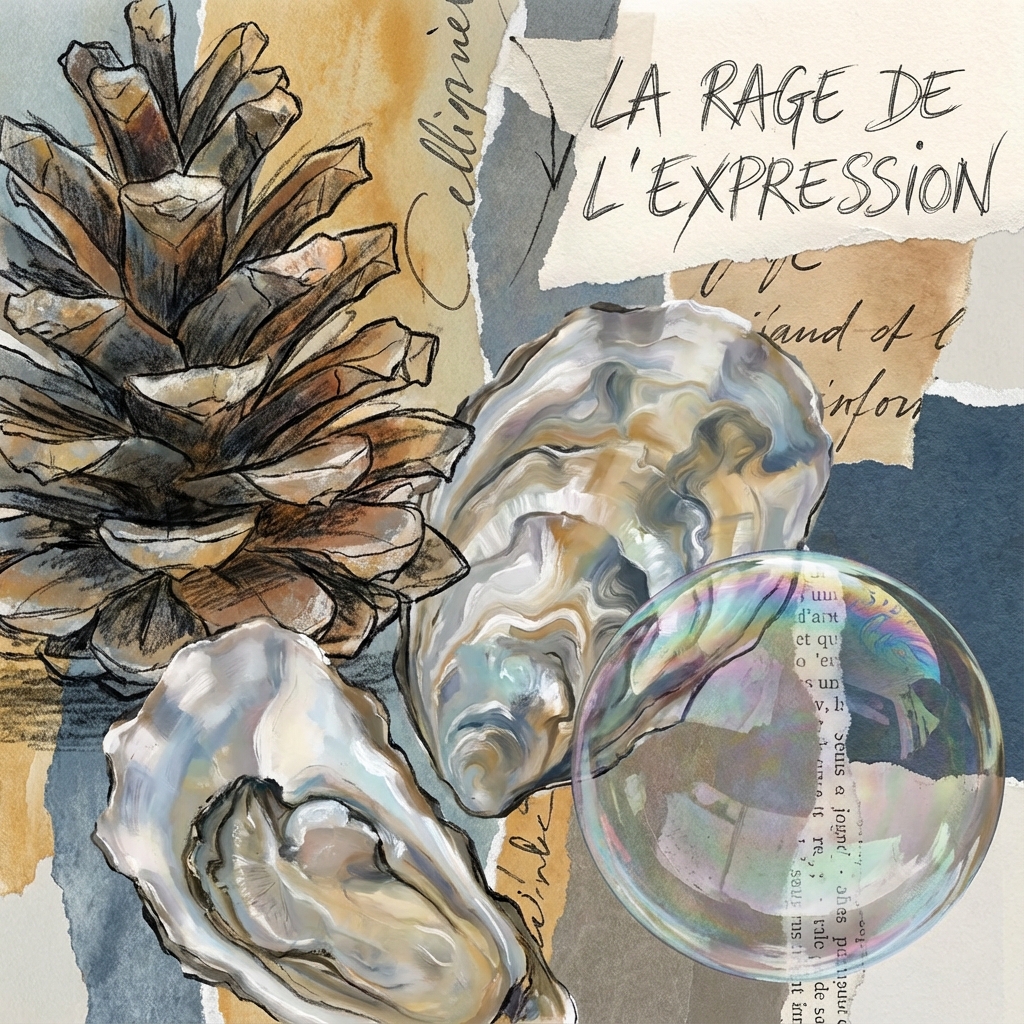
La Rage de l'expression
"I don't want to say it approximately."
BIOGRAPHY: Francis Ponge (1899-1988)
📅 Essential Chronology
The Man of Silence
- 1899: Born in Montpellier into a Protestant family.
- The Founding Failure: He failed the oral examination for the philosophy teaching certification (agrégation). This failure marked him and fueled his distrust of oral speech and easy rhetoric. He chose writing, silence, objects.
- Surrealism: He frequented the Surrealist group in the 1920s but soon distanced himself. He preferred concrete reality to dreams.
Le Parti Pris des Choses (1942)
- The Revelation: His first major collection made him famous. In it, he describes mundane objects (bread, orange, pebble) to restore their dignity. Sartre praised his poetic materialism.
- Engagement: He briefly joined the Communist Party (1937-1947) and participated in the Resistance.
La Rage de l'Expression (1952)
- Evolution: This collection marks a turning point. Ponge no longer simply delivers the finished poem (the perfect "definition"). He wants to show the work of writing, the erasures, the hesitations. This is entry into the poet's workshop.
- Consecration: He became a major figure in contemporary poetry (Tel Quel group).
🎭 The Work and Its Context
Refounding Language
Ponge starts from an observation: language is "clogged." Words are worn out by everyday use, they no longer express reality. His goal is to "clean" words (through etymology, sound play) so they stick to things again. It's an enterprise of public sanitation.
DETAILED SUMMARY
A Workshop-Collection
This book is not a series of perfect poems. It's a dossier, a logbook. Ponge gathers 7 texts that are as many open construction sites.
1. Berges de la Loire
The poet attempts to describe a landscape without falling into romantic lyricism. He fails, starts over, criticizes his own attempts ("This is too poetic"). It's an admission of the difficulty of expressing nature simply.
2. La Guêpe
The insect becomes an allegory of writing: lively, stinging, "striped." Ponge seeks to make his text buzz and attack like the animal. He compares his state of intellectual excitement to the frenetic activity of the wasp.
3. Notes prises pour un oiseau
A series of definitions revised and corrected. Ponge proceeds by elimination to isolate the essence of the bird (its lightness, its relationship to air) from everything it is not.
4. L'Œillet
A struggle with the word itself. Ponge dissects "Œillet" (which contains "Œil" - eye), explores the crumpled texture of the flower ("chiffon" - rag). It's a fight to make word and thing coincide.
5. Le Mimosa
The attempt to capture the ephemeral. The mimosa wilts quickly, like inspiration. Ponge tries to fix this "golden dust" before it disappears.
6. Le Carnet du bois de pins
The most experimental text. Ponge notes everything: the forest, but also the weather, his readings, his doubts, the dates of his walks. The forest producing deadwood becomes the mirror of the poet producing drafts.
7. La Mounine
Description of a Provençal landscape. Ponge seeks to capture the light and smell of the garrigue.
GLOBAL ANALYSIS
📊 Overview
La Rage de l'expression is a revolutionary work because it exposes the scaffolding of poetry. Ponge shows that poetry is not a miracle, but work—relentless work, a struggle against silence and approximation.
🎯 Essential Characteristics
The Aesthetics of the Draft
Ponge publishes his erasures. He dates his paragraphs, writes "No, that's not it," "Let's start again." He transforms temporary failure into a form of art. The reader witnesses the birth of the text in real time.
The Objeu and the Proème
Ponge invents concepts:
- The Objeu (Object + Jeu/Game): The text must become an autonomous object that "plays" with the rules of language to mimic the thing.
- The Proème (Prose + Poem): A dense text that refuses the ease of verse to confront the roughness of prose.
Poetic Materialism
Ponge rejects feelings ("No feelings!"). He doesn't speak of his soul, but of the matter of the world. He wants to reconcile man with objects by understanding them from within.
MAIN THEMES
📝 Critique of Language
This is the central theme. Words are lying "labels." Saying "it's beautiful" is not enough. We must find the right word, unique, that can only apply to that particular object. It's a "rage" because language resists.
🔨 Work and Workshop
Writing is presented as craftsmanship. Ponge "tinkers," "files," "polishes" his texts. He compares the poet to a worker or a factory (the pine forest). He desacralizes romantic inspiration.
🌍 The Object-King
Ponge gives voice to the mute (things). He respects their otherness. The pine, the wasp, the pebble have their own existence, indifferent to man. The goal is to grasp this "differential quality" of each object.
⏳ Time and Genesis
Unlike Le Parti pris des choses (static), this collection introduces time. The time of writing (dates in the notebook) and the time of the object (the wilting mimosa). The work is a process, not a result.
ASSOCIATED PATHWAY: In the Poet's Workshop
🎯 Pathway Objective
This pathway invites us to consider poetry as fabrication (poïesis in Greek = to make). The workshop is the place where we see the artist at work, with their tools and failures.
📚 Pedagogical Sequence
1. Refusal of the Finished Poem
Ponge shows that the "finished" is an illusion, even a lie. The draft is truer because it keeps the trace of effort. The work is always "in progress."
2. The Poet's Tools
In his workshop, Ponge uses:
- The Dictionary (Littré): To recover the etymological and concrete meaning of words.
- Phonetics: So the sound of the word imitates the object (the sharp "i" of the wasp).
- Typography: The visual layout of the text.
3. The Object Lesson
The workshop is also a scientific laboratory. Ponge observes the object under a magnifying glass. He mixes poetry and science to achieve an exact "definition-description."
Key Words of the Pathway
- Genesis: Birth of the work.
- Variant: Different versions of the same sentence.
- Labor: The physical effort of writing.
- Incompleteness: The openness of the work.
KEY QUOTATIONS
1. The Rage
"This is approximately what I want to say; but I don't want to say it approximately."
- (L'Œillet)
- Analysis: The key phrase. It summarizes the conflict between intention (to speak truth) and tool (imprecise language). It's this refusal of approximation that creates the work's dynamic.
2. The Parti Pris
"I took the side of things against words."
- (Méthodes)
- Analysis: Ponge chooses the camp of reality. If the word doesn't stick to the thing, it's the word that must be changed, twisted, broken.
3. Identification
"The wasp is [...] the state I'm in when I 'tinker' or 'polish' a text."
- (La Guêpe)
- Analysis: The poet becomes what he describes. Writing is a stinging, vibrant, dangerous activity like the insect.
4. Incompleteness
"Everything here is dead, or at least everything, having lived, is transformed into dry matter."
- (Le Carnet du bois de pins)
- Analysis: The finished poem is "dead" (dry). Only the draft is alive. Ponge prefers life (the process) to mummification (the frozen work of art).
ESSAY TOPICS
Topic 1: The Draft
"How does the refusal of the finished poem constitute a new form of poetry in La Rage de l'expression?"
Reflection Points
- Truth vs Beauty: Ponge sacrifices formal beauty for the truth of the search.
- The reader as witness: The reader is invited to participate in creation, entering the poet's mind.
- A poetics of movement: Poetry is no longer a static object, but a dynamic, an impulse.
Topic 2: The Workshop
"Does the image of the poet's workshop correspond to what Ponge gives us to read?"
Reflection Points
- Yes, the construction site: We see the tools, shavings, dust (the erasures).
- No, a learned construction: This "disorder" is organized. Ponge chose to publish these notes. It's a "feigned disorder" to create an effect of reality.
- A mental workshop: It's the workshop of the French language itself that Ponge explores.
Topic 3: Things
"Does Ponge succeed in giving voice to things?"
Reflection Points
- Impossible objectivity: It's always a man speaking. The pine doesn't speak.
- Anthropomorphism avoided: Ponge avoids projecting his feelings. He seeks the object's own laws.
- The objeu: He creates a verbal object that is the equivalent of the thing. He doesn't give voice to the thing, he creates a thing in words.
Express Quiz
Loading...
Session Complete!
Not bad!