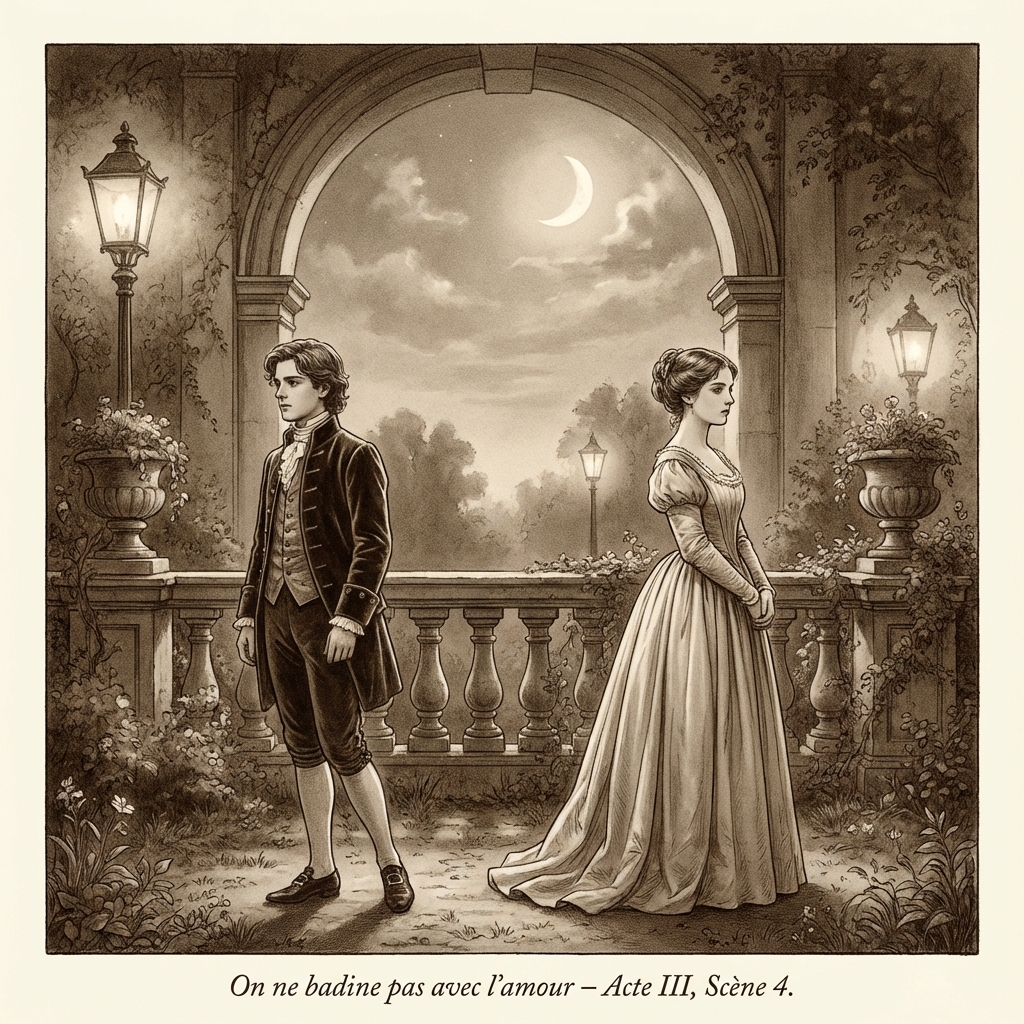
On ne badine pas avec l'amour
"Pride is a steep slope to be climbed barefoot."
BIOGRAPHY: Alfred de Musset (1810-1857)
📅 Essential Chronology
Child of the Century
- 1810: Born in Paris into a cultured family.
- 1828: A brilliant student, he frequented Victor Hugo's Romantic Cénacle at 17 years old.
- 1830: Failure of his first play La Nuit vénitienne. He decided to stop writing for the stage but for reading ("A spectacle in an armchair").
Passion and Pain
- 1833-1835: Tumultuous affair with George Sand. Trip to Italy, illness, betrayal. This painful experience nourished his masterpieces: Lorenzaccio and On ne badine pas avec l'amour (1834).
- 1836: Publication of La Confession d'un enfant du siècle, an autobiographical novel about the "mal du siècle" (sickness of the century).
Early Decline
- 1845: Received the Legion of Honor but his health declined (alcohol, depression).
- 1852: Election to the French Academy.
- 1857: Died at 46 from heart failure.
🎭 The Work and its Context
Romantic Drama
Musset embodies Romanticism par excellence: lyricism, exaltation of the self, mixture of genres (comic and tragic). But he distinguished himself through biting irony and disillusioned lucidity about human nature.
DETAILED SUMMARY
Act I: The Reunion
The Baron awaits the return of his son Perdican (recently graduated) and his niece Camille (leaving the convent). He has planned to marry them. The two young people arrive, accompanied by their grotesque tutors (Master Blazius and Dame Pluche).
Perdican is happy to see Camille again and the places of his childhood. Camille, on the other hand, is cold, distant and refuses her cousin's kiss. She announces that she wants to return to the convent to devote herself to God.
Act II: The Challenge
Stung by Camille's coldness, Perdican seeks to understand. Camille confesses to him that she is afraid of love because her convent friends told her about their romantic sufferings. She wants eternal and perfect love, or nothing.
Perdican responds with a famous tirade on the necessity of loving despite suffering ("We are often deceived in love... but we love").
To avenge Camille's indifference, Perdican decides to seduce Rosette, Camille's foster sister, a naive peasant girl. He courts her before Camille's eyes.
Act III: The Tragedy
Camille, jealous, summons Perdican. She confesses that she still loves him. But she discovers that Perdican has promised to marry Rosette. She then reveals to Rosette that Perdican does not love her and that he used her to make Camille jealous.
Perdican, cornered, decides out of pride to actually marry Rosette. But at the decisive moment, he realizes he loves Camille. He runs to join her at the oratory. They fall into each other's arms.
A cry rings out: Rosette, hidden behind the altar, has heard everything and falls dead from emotion (or commits suicide).
Before this corpse, love becomes impossible. Camille concludes: "She is dead. Farewell, Perdican." The lovers part forever.
GLOBAL ANALYSIS
📊 Overview
On ne badine pas avec l'amour (1834) is a dramatic proverb. This genre, originally light and worldly, is transformed by Musset into a poignant drama. The play literally illustrates the title: toying with love (badiner) leads to death.
🎯 Essential Characteristics
The Mixture of Tones (Grotesque and Sublime)
- The Grotesque: Puppet characters like Blazius, Bridaine and Dame Pluche bring a comic, satirical dimension (criticism of the clergy and rigid education).
- The Sublime: Scenes between Perdican and Camille reach a rare lyrical and tragic intensity.
The Drama of Incommunicability
The two heroes love each other but cannot say it simply. They wear masks:
- Camille wears the mask of the cold devout to protect herself from suffering.
- Perdican wears the mask of the casual libertine to hide his wound.
It is pride that prevents them from coming together.
MAIN THEMES
💔 Love and Suffering
This is the central theme. Musset poses an existential question: is it better never to love to avoid suffering (Camille's thesis) or to love at the risk of suffering (Perdican's thesis)?
The play proves Perdican right ("It is I who have lived") but the tragic ending proves Camille's fear right.
🎭 The Mask and the Game
The characters play roles. Perdican plays the comedy of love with Rosette. Camille plays the comedy of indifference. This "badinage" is a dangerous game that traps its creators. The play denounces the hypocrisy of amorous language.
⚖️ Education and Religion
Musset criticizes religious education that distorts judgment. Camille was "intoxicated" by the stories of frustrated old nuns. She has a theoretical and morbid vision of love even before having experienced it.
🌾 Nature vs Culture
- Rosette embodies nature, simplicity, innocence. She does not know how to lie.
- Camille and Perdican are cultured beings, sophisticated, capable of duplicity. Their complexity destroys Rosette's simplicity.
ASSOCIATED PATHWAY: Games of the Heart and Word
🎯 Pathway Objective
This pathway invites reflection on the links between amorous feeling (the heart) and its expression (the word). How can words say, hide, or betray the heart?
📚 Pedagogical Sequence
1. Words as Mask
In the play, words often serve to hide the truth of the heart. Camille says she doesn't love to protect herself. Perdican says he loves Rosette to hurt Camille. Language is a weapon of defense or attack, not a tool for sincere communication.
2. Badinage: A Dangerous Game
"Badinage" is light speech about a serious subject. Musset shows the danger of this disconnect. Using the words of love without having the feeling (with Rosette) is a moral crime that kills.
3. The Word of Truth
There are moments of dazzling truth (the monologues, the final scene). But this truth often comes too late. The drama arises from the temporal gap between the cry of the heart and its formulation.
Pathway Keywords
- Gallant: Who seeks to please through words.
- Spite: Amorous anger that makes one say the opposite of what one thinks.
- Blindness: Not seeing one's own truth or that of the other.
- Performative: A word that acts (the promise of marriage).
KEY CITATIONS
1. Hymn to Love (Perdican)
"All men are liars, inconstant, false, talkative, hypocrites, proud and cowardly [...] but there is in the world one thing holy and sublime, it is the union of two of these beings so imperfect and so dreadful."
- (Act II, scene 5)
- French original: "Tous les hommes sont menteurs, inconstants, faux, bavards, hypocrites, orgueilleux et lâches [...] mais il y a au monde une chose sainte et sublime, c'est l'union de deux de ces êtres si imparfaits et si affreux."
- Analysis: This is the most famous tirade. Perdican accepts human imperfection. Love is the only possible redemption in a mediocre world.
2. Camille's Resolution
"I want to love, but I don't want to suffer."
- (Camille)
- French original: "Je veux aimer, mais je ne veux pas souffrir."
- Analysis: This is the impossible paradox. Camille wants the absolute without the risk. She refuses the human condition that links pleasure and pain.
3. Tragic Lucidity
"We are often deceived in love, often wounded and often unhappy; but we love, and when we are on the edge of our grave, we turn around to look back, and we say to ourselves: I have suffered often, I have been mistaken sometimes, but I have loved. It is I who have lived, and not a fictitious being created by my pride and my boredom."
- (Perdican, Act II, scene 5)
- French original: "On est souvent trompé en amour, souvent blessé et souvent malheureux ; mais on aime, et quand on est sur le bord de sa tombe, on se retourne pour regarder en arrière, et on se dit : J'ai souffert souvent, je me suis trompé quelquefois, mais j'ai aimé. C'est moi qui ai vécu, et non pas un être factice créé par mon orgueil et mon ennui."
- Analysis: The Romantic credo. Suffering is proof of life. Better to suffer than to feel nothing.
4. The Final Sentence
"She is dead. Farewell, Perdican."
- (Camille, Act III, scene 8)
- French original: "Elle est morte. Adieu, Perdican."
- Analysis: The brutality of the fall. Rosette's death makes Camille and Perdican's love monstrous. They are separated forever by this corpse.
DISSERTATION TOPICS
Topic 1: The Tragic and the Comic
"How does the mixture of genres in On ne badine pas avec l'amour reinforce the tragic dimension of the play?"
Reflection Points
- The contrast: Comic scenes (Blazius drunk) make dramatic scenes more intense through rupture effect.
- The satire: The ridiculousness of puppets underlines the gravity of heroes.
- Tragic irony: Laughter gradually freezes to give way to horror (Rosette's death).
Topic 2: Amorous Language
"Is language an obstacle or a means of love in the play?"
Reflection Points
- The obstacle: Misunderstandings, unspoken words, pride that prevents confession.
- The weapon: Manipulative words to make jealous.
- The means: Moments of grace where words liberate (the letter, the final confession).
Topic 3: Learning About Love
"Can we say that the play is the story of a painful learning of truth?"
Reflection Points
- Initial illusion: Camille believes she knows what love is through books/stories. Perdican believes he masters the game.
- The ordeal: Confrontation with reality, with jealousy, with the other's suffering.
- The final lesson: Truth breaks out too late. We learn not to toy, but at the cost of a life.
Express Quiz
Loading...
Session Finished!
Not bad!