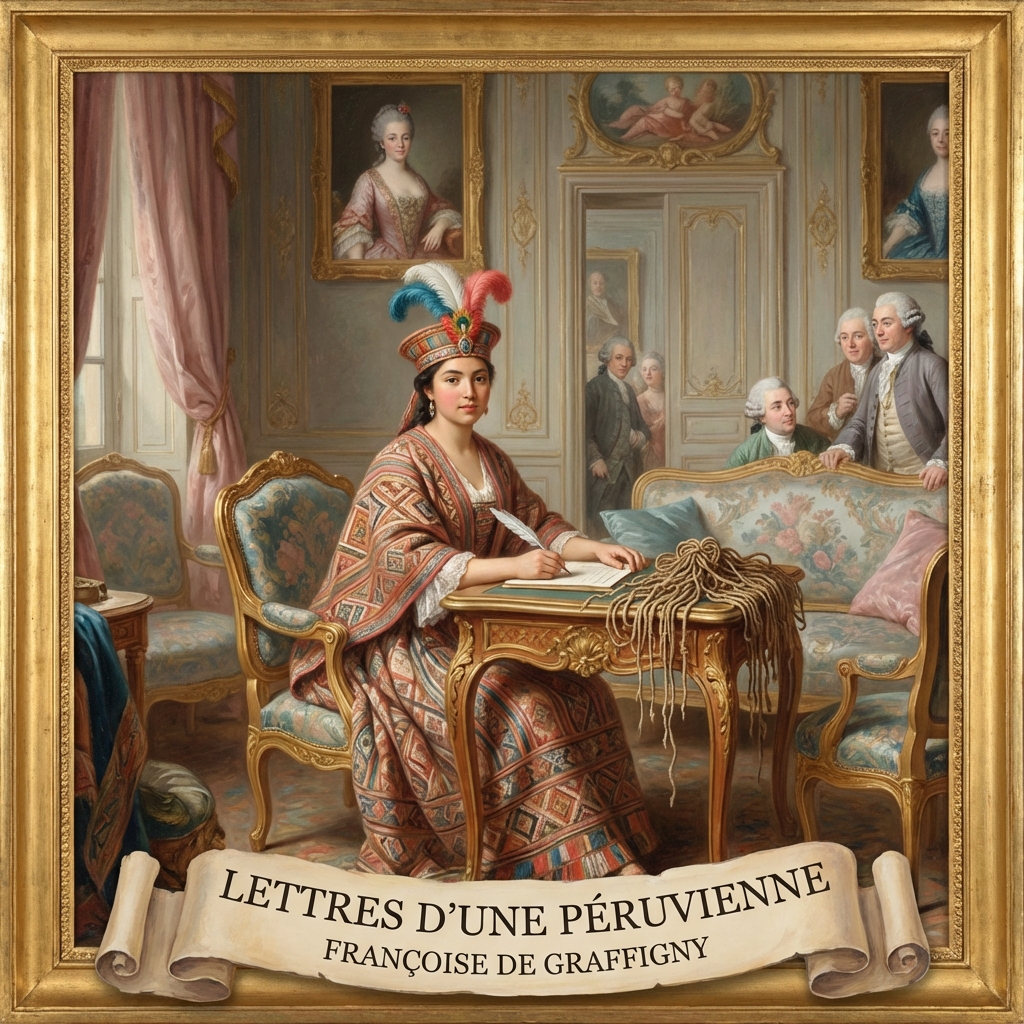
Lettres d'une Péruvienne
BIOGRAPHY: Françoise de Graffigny (1695-1758)
📅 Essential Chronology
Youth and Formation (1695-1725)
- 1695: Born in Nancy into a noble family.
- 1712: Marriage to François Huguet de Graffigny.
- 1718: Widowhood and beginning of financial independence.
- 1725: Settlement in Paris, beginning of literary circles.
Parisian Life and Creation (1725-1740)
- 1725-1735: Frequenting literary salons.
- 1735: Installation at the Court of Lorraine in Lunéville.
- 1738: Meeting with Voltaire and the philosophers.
- 1740: Beginning of professional writing.
Period of Success (1740-1758)
- 1747: Publication of Lettres d'une Péruvienne.
- 1748: International success, multiple translations.
- 1749-1750: Cénie, a successful drama.
- 1758: Death in Paris, leaving a considerable body of work.
🎯 The Work and Its Context
Lettres d'une Péruvienne (1747)
- Context: Success of epistolary novels.
- Innovation: Feminine voice and foreign perspective.
- Reception: Enthusiastic welcome in Europe.
Salon Life and Enlightenment
- Graffigny's Salon: Meeting place of the Enlightenment.
- Correspondence: European network of intellectuals.
- Influence: Role as a recognized woman of letters.
Woman of Letters and Witness
- Financial Autonomy: Rare for a woman of the era.
- Social Criticism: Through the foreign gaze.
- Modernity: Anticipation of postcolonial debates.
🏛️ Reception and Posterity
Immediate
- Translations: English, German, Italian, Spanish.
- Adaptations: Theater, opera, illustrated versions.
- Influence: Model for feminine epistolary novels.
Posterity
- Romanticism: Source of inspiration for the exotic gaze.
- Women Writers: Model of feminine emancipation.
- Postcolonial Studies: Founding text of the cross-cultural perspective.
DETAILED SUMMARY
📖 Letters 1-10: Uprooting and Discovery
Letter 1: The Capture
Context: Zilia, a young Peruvian noblewoman, is captured by the Spaniards.
- Triggering Event: Spanish attack on the Temple of the Sun.
- Separation: From Aza, her Inca fiancé.
- First Letter: Despair and call for help.
Letters 2-5: The Transatlantic Journey
Stage: Crossing the Atlantic.
- Conditions: Captivity, uncertainty.
- Observations: First contact with Europe.
- Emotions: Fear, curiosity, resignation.
Letters 6-10: Arrival in France
Discovery: First look at Europe.
- Astonishment: Facing French customs.
- Comparison: Between civilizations.
- Questioning: Of European values.
🌸 Letters 11-20: Learning and Analysis
Letters 11-15: Observation of Manners
Analysis: Deep understanding of French society.
- Festivities: Judged excessive and frivolous.
- Relations: Complexity of social relationships.
- Women: Relative freedom but subtle constraints.
Letters 16-20: Language and Thought
Learning: Progressive mastery of French.
- Difficulties: Linguistic and cultural barrier.
- Progress: Understanding of nuances.
- Reflection: On the nature of communication.
💭 Letters 21-30: Emancipation and Criticism
Letters 21-25: Intellectual Independence
Development: Assertion of critical thinking.
- Analysis: Of French institutions.
- Criticism: Of social contradictions.
- Assertion: Of a personal vision.
Letters 26-30: Financial Autonomy
Achievement: Economic independence rare for a woman.
- Discovery: Of economic mechanisms.
- Autonomy: Management of her fortune.
- Freedom: Personal and professional choices.
🌟 Letters 31-34: Synthesis and Assertion
Letters 31-32: Nuanced Understanding
Assessment: Deep understanding of Europe.
- Relativism: Each culture has its virtues.
- Universality: Common human feelings.
- Wisdom: Overcoming prejudices.
Letters 33-34: Final Assertion
Conclusion: Assertion of identity and freedom.
- Independence: Master of her destiny.
- Choice: Refusal of social conventions.
- Message: Universality of human values.
GLOBAL ANALYSIS
📊 Overview
Lettres d'une Péruvienne is a major 18th-century epistolary novel, composed of 34 letters written by Zilia, a young Peruvian woman from the Inca nobility, to Déterville, her French correspondent. This innovative work combines travel narrative, social criticism, and feminine emancipation.
🎯 Essential Characteristics
Narrative Structure
- 34 letters: Chronological progression of the narrative.
- Epistolary form: Intimacy and subjectivity.
- Cross-cultural perspective: Peruvian view of Europe.
- Double temporality: Time of the narrative and time of writing.
Historical Context
- 1747: Eve of the Enlightenment, questioning of certainties.
- Colonial Peru: European view of America.
- Women's Condition: Emancipation and social constraints.
🔍 Thematic Analysis
1. The Foreigner's Gaze
- Decentering: Inverted perspective on Europe.
- Implicit Criticism: Of French manners.
- Discovery: Of otherness and oneself.
2. Feminine Emancipation
- Initiatory Journey: From captive to free woman.
- Intellectual Autonomy: Development of thought.
- Financial Independence: Rare for a woman of the era.
3. Enlightenment Criticism
- Questioning: Of European certainties.
- Cultural Relativism: Each culture has its value.
- Humanism: Universality of human feelings.
🎨 Formal Innovations
Language and Style
- Epistolary Style: Intimate and reflective.
- Critical Register: Observation and analysis.
- Feminine Voice: Rare in philosophical literature.
Structure
- Dramatic Progression: From personal drama to discovery.
- Alternation: Description and reflection.
- Openness: Ambiguous and modern ending.
MAIN THEMES
👁️ Theme 1: The Foreigner's Gaze
Definition of the Concept
- Decentering: Inverted perspective on Europe.
- Astonishment: Facing French customs.
- Implicit Criticism: Of European manners.
In the Letters
- Letters 1-10: First cultural shock.
- Letters 11-20: In-depth analysis.
- Letters 21-30: Nuanced understanding.
- Letters 31-34: Synthesis and transcendence.
👩 Theme 2: Feminine Emancipation
Zilia's Journey
- Captive: Beginning of the narrative.
- Observer: Discovery of Europe.
- Thinker: Intellectual development.
- Free Woman: Identity assertion.
Forms of Emancipation
- Intellectual: Development of critical thinking.
- Financial: Rare economic independence.
- Social: Overcoming assigned roles.
🌍 Theme 3: Cultural Otherness
Confrontation of Cultures
- Inca Peru: Refined and complex civilization.
- Enlightenment France: Modernity and contradictions.
- Relativism: Each culture has its value.
Process of Understanding
- Astonishment: Facing differences.
- Analysis: Understanding of mechanisms.
- Synthesis: Overcoming prejudices.
ASSOCIATED PATH: Celebrating the World
🎯 Path Objective
"Celebrating the world" through the discovery of cultural otherness and feminine emancipation: understanding others to better understand oneself.
📚 Pedagogical Sequence
Stage 1: The Foreigner's Gaze
Objective: Develop a decentered perspective.
- Reading letters 1-10.
- Analysis of first impressions.
- Exercise: Describe your own culture as a foreigner.
Stage 2: Progressive Discovery
Objective: Understand cultural otherness.
- Reading letters 11-20.
- Study of cultural differences.
- Exercise: Create a cultural guide for a foreigner.
Stage 3: Feminine Emancipation
Objective: Follow Zilia's journey to freedom.
- Reading letters 21-30.
- Analysis of personal assertion.
- Exercise: Write a letter of emancipation.
Stage 4: Universal Synthesis
Objective: Extract universal values.
- Reading letters 31-34.
- Synthesis of learnings.
- Exercise: Humanist manifesto.
KEY QUOTATIONS
📝 Letters 1-10: First Cultural Shock
"I am in a country where everything is foreign to me"
- Letter 3: First look at Europe.
- Analysis: Statement of decentering, position as a foreigner.
"The French have very different customs from ours"
- Letter 5: Observation of customs.
- Analysis: Beginning of implicit criticism, cultural relativism.
🌸 Letters 11-20: In-depth Analysis
"This nation believes itself to be the most civilized of all"
- Letter 12: Criticism of Eurocentrism.
- Analysis: Subtle irony, deconstruction of certainties.
"French women have a freedom that we do not have"
- Letter 15: Observation on the feminine condition.
- Analysis: Comparison of feminine statuses, beginning of emancipation.
💭 Letters 21-30: Nuanced Understanding
"I now see that each nation has its virtues and its faults"
- Letter 23: Affirmed cultural relativism.
- Analysis: Overcoming prejudices, nuanced understanding.
"I am mistress of my heart and my fortune"
- Letter 28: Assertion of independence.
- Analysis: Complete emancipation, feminine autonomy.
🌟 Letters 31-34: Synthesis and Transcendence
"I have learned to know Europe and to know myself"
- Letter 32: Assessment of the journey.
- Analysis: Dialectic of otherness/identity, reciprocal knowledge.
ESSAY TOPICS
🎯 Essay Topics
1. The Foreigner's Gaze as Critical Method
"Is the foreigner's gaze in Lettres d'une Péruvienne an effective method of social criticism?"
Answer Framework
- Thesis: Fresh and objective perspective unmasking social arbitrariness.
- Antithesis: Partiality of the foreign gaze and limits of criticism.
- Synthesis: Productive dialectic between otherness and understanding.
2. Feminine Emancipation
"Do the Lettres d'une Péruvienne propose a model of feminine emancipation?"
Answer Framework
- Yes: Complete journey of empowerment.
- But: Within the limits of the Enlightenment century.
- Conclusion: Precursor model for following generations.
3. Cultural Otherness
"How does the novel treat cultural otherness?"
Answer Framework
- As Wealth: Diversity of cultures.
- As Challenge: Overcoming prejudices.
- As Opportunity: Reciprocal knowledge.
📝 Literary Commentary Topics
Letter 12: Criticism of Eurocentrism
"Analysis of the implicit criticism of French manners"
Detailed Outline
- Foreign Observation: Shocking details.
- Implicit Criticism: Under the veil of astonishment.
- Philosophical Lesson: Cultural relativism.
Letter 28: Assertion of Independence
"Study of feminine emancipation in letter 28"
Detailed Outline
- Assertion: "Mistress of my heart".
- Means: Intellectual and financial independence.
- Scope: Model of emancipation.
Express Quiz
Loading...
Session Complete!
Not bad!