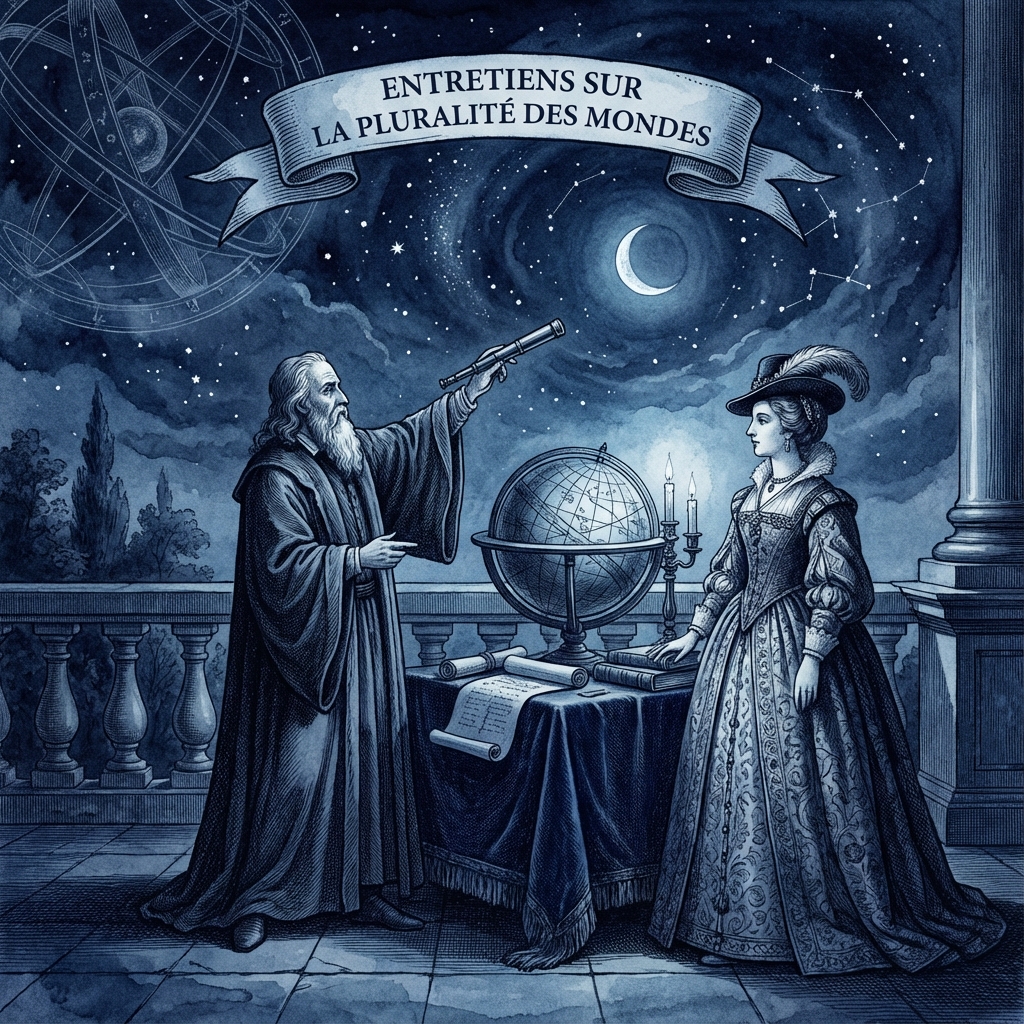
Entretiens sur la pluralité des mondes
BIOGRAPHY: Bernard de Fontenelle (1657-1757)
📅 Key Timeline
An Exceptional Longevity (1657-1757)
- 1657: Born in Rouen. He is the nephew of Pierre Corneille.
- Education: Studied with the Jesuits. He first attempted law, then turned to literature.
- The Centenarian: He died almost centenarian (one month short). He lived through the century of Louis XIV and a good part of that of Louis XV, bridging the gap between Classicism and the Enlightenment.
The Man of Science and Letters
- 1686: Publication of Entretiens sur la pluralité des mondes. Immediate success that made him famous in salons.
- 1691: Elected to the French Academy (after 4 rejections).
- 1697: Became Perpetual Secretary of the Academy of Sciences. He wrote the Éloges des académiciens, helping to make science a noble and literary subject.
- Quarrel of the Ancients and Moderns: He took the side of the Moderns, asserting that reason and science progress over time.
🎯 The Work and Its Context
The Brilliant Popularizer
Fontenelle is not a discoverer (like Newton or Descartes), but a mediator. He has the genius of clarity. He translates complex concepts (Copernican astronomy, Cartesian physics) into worldly language, accessible even to "ladies".
The Precursor of the Enlightenment
Although a 17th-century man, he announces the critical spirit of the 18th century:
- He combats prejudices and superstition (Histoire des Oracles, 1687).
- He believes in the progress of the human mind.
- He advocates a rational and skeptical method.
DETAILED SUMMARY
Preface
Fontenelle explains his goal: to treat philosophy in a manner that is not overly philosophical. He wants to entertain people of society and instruct the learned. He defends Copernicus's system.
First Evening: That the Earth is a Planet that Rotates on Itself and Around the Sun
- The narrator and the Marquise stroll in the evening.
- The narrator compares the universe to an opera performance: one sees the scenery but not the machinery (the backstage). The philosopher is the one who wants to see the ropes and pulleys.
- He explains that nature is a great simple machine.
- He demonstrates that the Sun is fixed and that the Earth rotates (more plausible than an immense Sun rotating around a small Earth).
- The Marquise accepts this idea despite the dizziness it causes.
Second Evening: That the Moon is an Inhabited Earth
- Observation of the Moon.
- Analogy: The Moon has spots like the Earth (mountains, supposed seas). It doesn't shine by itself but reflects the Sun. Therefore, it resembles the Earth.
- If it resembles the Earth, it is probably inhabited.
- Discussion about the nature of "Selenites" (inhabitants of the Moon). They probably don't resemble us (as Americans don't resemble Europeans, but even more different).
Third Evening: Peculiarities of the World of the Moon. That Other Planets are Also Inhabited
- Comparison of living conditions on the Moon (days and nights of 15 terrestrial days).
- Extension of the reasoning to Venus, Mars, Mercury.
- The Marquise worries: "The universe is so vast that I'm lost in it". The narrator reassures her: this immensity is a sign of God's greatness and nature's fertility.
Fourth Evening: Peculiarities of the Worlds of Venus, Mars, Mercury
- Amusing speculations on the temperament of inhabitants according to distance from the Sun (theory of climates).
- The inhabitants of Venus (hot) are gallant and amorous.
- The inhabitants of Mercury are mad with vivacity (too much sun).
- The inhabitants of Saturn (cold) are slow and phlegmatic.
- Earth is in the middle, the ideal climate for reason (ironic).
Fifth Evening: That Fixed Stars are as Many Suns Each Illuminating Worlds
- Cosmic vertigo. Each star is a Sun.
- Each Sun probably has its planets (vortices).
- The universe is infinite. Earth is just a speck of dust.
- Reflection on man's place: human pride takes a hit, but reason emerges greater.
Sixth Evening (Added in 1687): New Thoughts Confirming Those of Previous Conversations
- The narrator returns to objections and provides clarifications.
- He compares the universe and nature to an infinite diversity governed by constant laws.
- Gallant conclusion: The Marquise now has "the entire sky in her head".
GLOBAL ANALYSIS
📊 Overview
Published in 1686, this text is foundational to scientific popularization. Fontenelle presents Copernicus's system (heliocentrism: the Earth revolves around the Sun) and Descartes' physics (vortices) in the form of a gallant dialogue.
🎯 Essential Characteristics
The Setting: A Gallant Astronomy Lesson
- The Characters: A narrator (the philosopher/scholar) and a Marquise (G..., cultured but ignorant in science).
- Place and Time: The park of a castle, at night. Setting conducive to reverie and sky observation.
- The Tone: The conversation is light, playful, full of wit. Fontenelle applies Horace's principle: Placere et docere (Please and instruct). One speaks of cosmic vortices as one would speak of an opera.
The Project: Desacralizing the Sky
- The End of Anthropocentrism: Earth is no longer the center of the world, it's a planet like the others.
- Analogy: Fontenelle uses reasoning by analogy. If Earth is inhabited and resembles other planets, then other planets are probably inhabited.
- Rationality: He eliminates the marvelous and religious to explain the universe through mechanics (the universe is a "great watch").
Literary Stakes
- Literature of Ideas: Fontenelle uses rhetoric to convince.
- Classical Aesthetics: Clarity, measure, propriety.
- Intellectual Feminism: He addresses a woman, asserting that science is not reserved for men, provided it is explained simply.
MAIN THEMES
1. The Plurality of Worlds (Exobiology Before Its Time)
This is the central theme.
- Analogy: If nature is fertile on Earth, why would it be sterile elsewhere?
- Diversity: Each planet has its inhabitants adapted to its climate. It's a hymn to the variety of creation.
- Relativity: We are not the center. Other beings perhaps think we don't exist.
2. Scientific Popularization
Fontenelle invents a genre.
- Clarity: Explain the complex through the simple.
- Metaphor: Use familiar images (the opera, the blonde, the vortex).
- Dialogue: Science is built in exchange, not in magisterial monologue.
3. Reason Against Prejudice
The Enlightenment struggle begins here.
- Critique of Authority: We don't believe Aristotle, we believe reason and observation.
- Critique of Anthropocentrism: Man is not the end of creation. The Sun was not made to illuminate man, but to illuminate worlds.
- Refusal of the Marvelous: Comets are not omens of misfortune, they are celestial bodies that follow laws.
4. Intellectual Feminism
The Marquise is not a decorative object.
- Female Intelligence: She understands quickly, poses good objections (often common sense) and pushes the philosopher into his retrenchments.
- Access to Knowledge: Fontenelle asserts that the difference between sexes is not intellectual. He opens the door of science to women.
5. Gallant Aesthetics
Form influences content.
- Seduction: The astronomy lesson is also a scene of seduction. The philosopher courts the Marquise's mind.
- Banter: Serious things (infinity, death, God) are discussed with lightness and smile. It's the politeness of the mind.
ASSOCIATED THEME: The Taste for Science
🎯 Theme Objective
This theme explores how literature seizes science not to complicate it, but to make it "agreeable" and accessible. It's about studying the alliance between knowledge (reason) and savor (literary pleasure).
📚 Educational Sequence
1. Science as Pleasure (The Taste)
Fontenelle rejects the idea that science must be austere, boring or reserved for pedants (scholars in black robes speaking Latin).
- Conversation: The dialogue form makes science alive. One doesn't read a treatise, one listens to two friends discuss.
- Imagination: Fontenelle uses pleasant metaphors (planets are dancers, nature is a theater). He appeals to dreams (inhabitants of the Moon).
2. Science as Method (Reason)
"The taste for science" is not superficial. Fontenelle teaches a rigorous method.
- Doubt: One must believe nothing without proof ("Let us be sure of the fact before worrying about the cause").
- Analogy: It's the main tool to extend our knowledge. If A resembles B, and A has such property, then B perhaps has it too.
- Positive Disenchantment: Science "cleans" the world of myths and superstitions. This may seem sad (the Moon is no longer a goddess), but it's actually exhilarating (it's a new world to explore).
3. Science for All (Democratization)
The choice of a woman (the Marquise) as interlocutor is political.
- If a marquise can understand astronomy, everyone can do it.
- Science is part of the culture of the honest man (and woman) of the 17th century, as much as music or poetry.
Keywords of the Theme
- Popularization: Making vulgar (in the noble sense: common, accessible) what was sacred.
- Gallant: The elegant and polite style of worldly conversation.
- System: The global explanation of the world (Copernicus, Descartes).
- Curiosity: The engine of research.
KEY QUOTATIONS
On Popularization and Clarity
"I ask of the Ladies, for all this System of Philosophy, only the same attention that must be given to La Princesse de Clèves."
- (Preface)
- Commentary: Fontenelle desacralizes science. He puts it on the same level as a fashionable novel. Understanding astronomy doesn't require superhuman genius, just attention.
"True philosophy is to learn new truths and to tire of old ones."
- Commentary: Definition of intellectual pleasure. Science is a remedy against boredom and frozen tradition.
On the Universe and the Machine
"I always imagine that nature is a great spectacle resembling that of the Opera."
- (First Evening)
- Commentary: The theatrical metaphor. The universe is machinery. The role of the scholar is to go behind the scenery to see the "ropes" (physical laws).
"The Universe is so vast that I'm lost in it. I no longer know where I am, I am nothing anymore."
- (The Marquise, Third Evening)
- Commentary: The expression of vertigo (Pascal's "eternal silence of infinite spaces"). But here, the vertigo is quickly soothed by reason.
On Relativity and Anthropocentrism
"Do we claim to be the only inhabitants of the earth because we are?"
- (Reasoning by analogy)
- Commentary: Critique of human pride that believes itself alone and central.
ESSAY TOPICS
Topic 1: Science and Literature
Topic: "In the preface to the Entretiens, Fontenelle declares he wants to 'treat philosophy in a manner that is not overly philosophical'. In what way is literature here a necessary ally of science?"
Reflection Points
- Literature as Pedagogy: Metaphor, image, narrative allow visualization of the abstract. Literature gives "body" to ideas (vortices, inhabitants of the Moon).
- Literature as Seduction: Arid science repels. Gallant style attracts the reader. The pleasure of reading leads to the pleasure of understanding (placere et docere).
- The Limit of the Alliance: Doesn't literature risk betraying science by oversimplifying? ("Science for ladies" can be seen as reduced science, but Fontenelle defends against this).
Topic 2: Knowledge and Happiness
Topic: "Is the scientific knowledge of the universe, as presented by Fontenelle, a source of anguish or happiness?"
Reflection Points
- Initial Anguish (Pascal): The infinite universe, Earth lost in the cosmos, man's solitude can frighten ("I am nothing anymore").
- The Happiness of Understanding (Fontenelle): This anguish is overcome by intellectual joy. Understanding the mechanism of the world is reassuring. The universe is not chaos, it's a regulated clock.
- Happy Humility: Losing one's central place (heliocentrism) allows one to shed one's pride. Man opens himself to otherness (the plurality of worlds).
Topic 3: The Figure of the Scholar
Topic: "What image of the scholar and science does Fontenelle construct in the Entretiens?"
Reflection Points
- The Honest Scholar: He is polite, sociable, doesn't speak Latin, doesn't cite authority (Aristotle). He is the opposite of Molière's pedant.
- Modest Science: The scholar doubts. He uses "I believe", "it seems to me". Science is not a dogma, it's a research in motion.
- Universal Science: Knowledge is not an ivory tower. It's shared in a garden, at night, with a witty woman.
Express Quiz
Loading...
Session Completed!
Not bad!