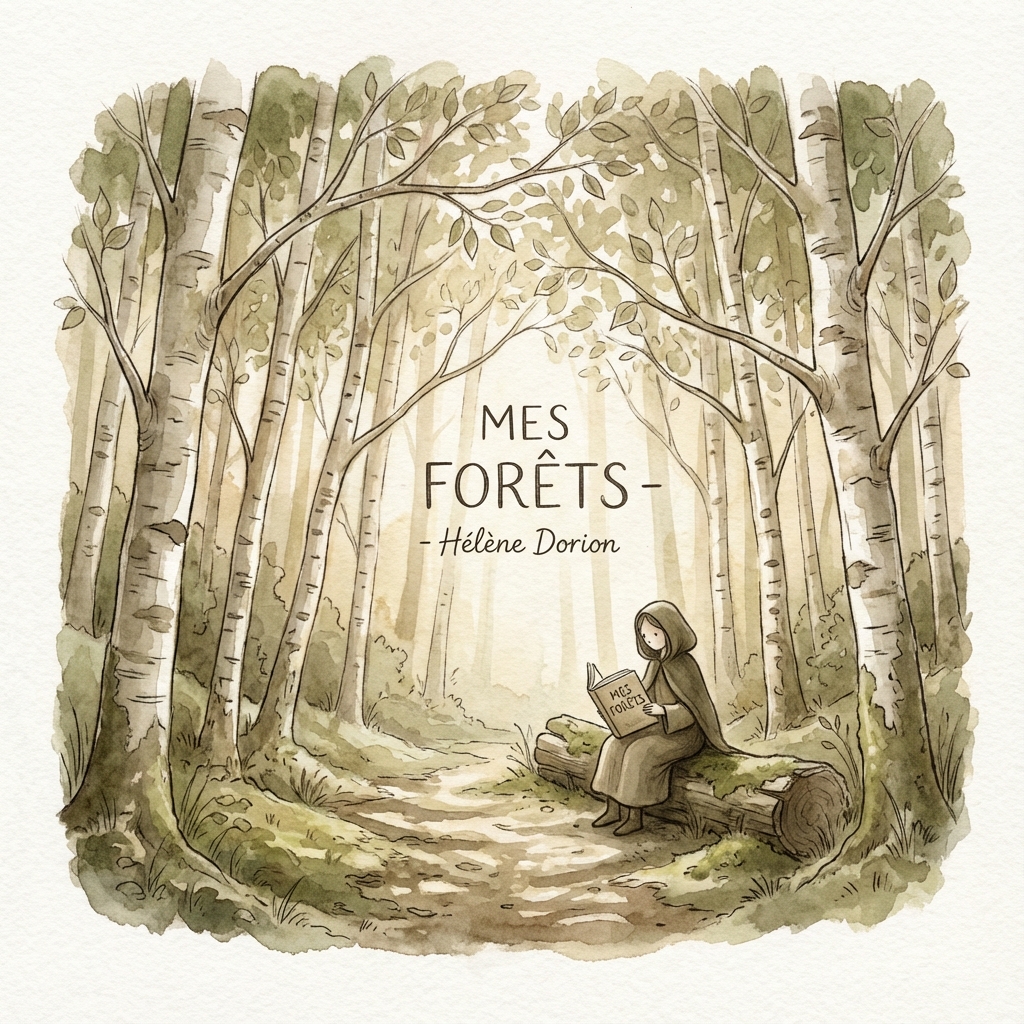
Mes forêts
BIOGRAPHY: Hélène Dorion (1958-)
📅 Essential Chronology
A Major Voice from Quebec
- 1958: Born in Quebec City (Canada).
- Status: She is one of the most important figures in contemporary Quebecois and Francophone literature.
- Baccalaureate Distinction: She is the first living Quebecois woman to be included in the French Baccalaureate program (in 2024).
A Prolific Body of Work
She has published over 30 books (poetry, novels, essays, children's books). Her work has been translated into about fifteen languages.
- Notable collections: Ravir : les lieux (2005), Le Hublot des heures (2008), Cœurs, comme livres d'amour (2012), Mes forêts (2021).
- Novels: Jours de sable (2002, Prix Anne-Hébert), Pas même le bruit d'un fleuve (2020).
🎯 The Work and its Context
Mes forêts (2021): A Work of Maturity
- Context: Published in 2021, in a context of ecological crisis and questioning of our relationship with the living world.
- Significance: This work crystallizes the concerns of a lifetime: the connection between the intimate and the collective, between the real forest and the interior forest.
- Reception: Recognized as a major work of contemporary Quebecois poetry, integrated into the 2026 French Baccalaureate program.
Style and Philosophy
Hélène Dorion is often described as a poet of interiority and meditation. She has a background in philosophy, which imbues her texts with constant metaphysical questioning, always grounded in sensation and emotion.
🏛️ Reception and Legacy
Recognition
She has received numerous prestigious awards, including:
- The Prix Mallarmé (2005) - the first Quebecois to receive it.
- The Prix Athanase-David (2019) - Quebec's highest literary distinction for a complete body of work.
- The Grand Prix de Poésie de l'Académie française (2024).
- The Governor General's Award of Canada (2006) for Ravissements.
DETAILED SUMMARY
General Structure
The collection Mes forêts (2021) by Hélène Dorion is organized into four sections that trace an initiatory journey, from anchoring to rebirth, through wounds and chaos.
1. L'écorce incertaine (The Uncertain Bark)
This first section establishes the foundations: anchoring, roots, the visible surface of the world. Exploration of surface, of the fragile contact between man and nature. Themes of birth and origin.
Main Themes
- Anchoring: Roots that plunge into the earth, the need for belonging.
- Verticality: Trees rising toward light, the quest for elevation.
- Surface: Bark as protection, as a boundary between interior and exterior.
2. Une chute de galets (A Fall of Pebbles)
This second section introduces rupture, wounds, the fall. Evocation of the passage of time, geological and human history, the "noise of the world."
Main Themes
- The Fall: Pebbles falling, the disruption of equilibrium.
- The Wound: Personal scars and Earth's wounds.
- Fragility: Instability, the precariousness of existence.
3. L'onde du chaos (The Wave of Chaos)
This third section plunges into disorder, loss, ordeal. A darker section, confronting the forest's beauty with the violence of human history and ecological disasters.
Main Themes
- Chaos: Disorder, confusion, loss of bearings.
- The Wave: Propagation, ripple effect, spreading impact.
- The Ordeal: Confrontation with difficulty, adversity.
4. Le bruissement du temps (The Rustling of Time)
This fourth and final section offers resilience, rebirth, hope. Return to a form of appeasement or acceptance, meditation on trace and memory.
Main Themes
- Rustling: The discreet yet present sound, life that continues.
- Time: Temporality, memory, duration.
- Rebirth: The humus that nourishes, the piercing light, hope.
GLOBAL ANALYSIS
📊 Overview
Mes forêts, published in 2021, falls within the course "Poetry, Nature, the Intimate" of the 2026 French Baccalaureate program. This work appears in a context of ecological crisis and profound questioning of our relationship with the living world. It proposes a poetry that connects personal experience to universal issues.
🎯 Essential Characteristics
Structure and Organization
The collection is constructed as an itinerary in four sections, punctuated by the cyclical return of the title poem "Mes forêts sont..." (My forests are...). This structure suggests an initiatory journey: from anchoring to wounds, then from loss to rebirth.
Genre and Style
- Genre: Contemporary poetry collection (free verse).
- Contemporary Lyricism: A poetry of "I" that is not narcissistic but universal. The "I" merges with "us" and with the landscape.
- Formal Fluidity: Absence of punctuation, brief free verse, spatial arrangement with typographic blanks.
🎨 Aesthetics and Writing
The Forest as a Double Metaphor
- Real Forest: Quebec nature, trees, vegetation, territory.
- Interior Forest: The unconscious, memory, strata of being, intimacy.
Vegetal Imagery
- Vocabulary: Roots, bark, sap, humus, light, shadow, verticality, fall.
- Metaphors: The tree as a figure of being, the forest as a space of memory.
🌍 Issues of the Collection
- Ecological: The forest is not a backdrop but a living subject, threatened, that must be listened to and protected.
- Ontological: The forest is a mirror of the human soul. Exploring the forest means exploring one's own interiority.
- Temporal: The forest embodies a "long time" that opposes the frenetic time of modernity.
- Therapeutic: Poetry seeks to "repair" the world and the subject, to mend what has been torn.
MAIN THEMES
🌲 The Forest as a Double Metaphor
The Real Forest and the Interior Forest
For Hélène Dorion, the forest is not just a landscape, it is a double space:
- Real forest: Quebec nature, trees, territory, visible landscape.
- Interior forest: The unconscious, memory, strata of being, the space of the soul.
🌍 Nature as a Mirror of Interiority
Exterior Landscape and Interior Landscape
Nature is not a simple backdrop, but a mirror of interiority:
- Trees reflect our verticality, our quest for light.
- Roots evoke our need for anchoring, for memory.
- The forest becomes the space where the soul unfolds.
💔 Wounds and Healing
Personal and Collective Wounds
- Intimate scars: Personal ordeals, losses, ruptures.
- The ecological wound: Environmental degradation, loss of biodiversity.
- Resilience: The humus that nourishes, the piercing light, the rustling of life that continues.
⏳ Time and Memory
Memory as Forest
- Strata: Layers of memory that accumulate.
- Anchoring: Roots that plunge into the past.
- Time as healing: Time allows for healing and rebirth.
🌱 Anchoring and Uprooting
Anchoring
- Roots: The need for belonging, for memory, for territory.
- Bark: Protection, the boundary between self and world.
Uprooting
- The Fall: Loss of anchoring, rupture.
- Chaos: Loss of bearings, confusion.
ASSOCIATED COURSE: Poetry, Nature, the Intimate
🎯 Course Objective
This course invites reflection on how poetry can weave connections between personal experience and universal issues, between the contemplation of nature and the exploration of interiority.
📚 Pedagogical Sequence
1. Poetry as Mediation Between the Intimate and the Universal
Poetry makes it possible to create connections between the individual and the collective (my forest / our forests), the intimate and the universal (personal wound / Earth's wound).
2. Nature as a Mirror of Interiority
Nature is not a simple backdrop, but a mirror of interiority. Trees reflect our verticality, roots our need for anchoring.
3. The Intimate as an Opening to the Universal
The intimate is not withdrawal into oneself, but opening. Exploring one's own forest allows us to understand others' forests. Individual experience becomes a bearer of collective meaning.
Keywords of the Course
- Mediation: Poetry connects what is separated.
- Mirror: Nature reflects the soul.
- Opening: The intimate opens to the world.
- Repair: Poetry heals wounds.
KEY QUOTATIONS
1. Opening and Definition
"Mes forêts sont de longues traînées de temps" (My forests are long trails of time)
- (Introductory poem)
- Analysis: The forest is defined as a temporal dimension, a living memory.
2. The Function of the Forest
"Mes forêts sont un long passage pour nos mots d'exil et de survie" (My forests are a long passage for our words of exile and survival)
- Analysis: The forest is a refuge for modern exiled man, a place of spiritual survival.
3. Critique of Modernity
"Il fait un temps d'insectes et d'algorithmes" (It is a time of insects and algorithms)
- Analysis: Violent contrast between the natural and the artificial, summarizing our epoch.
4. The Intimate and the Universal
"Je suis une forêt qui s'apprend" (I am a forest learning itself)
- Analysis: Total identification between the "I" and the "forest." Exploring oneself is a learning process.
"Je dis 'mes forêts' / mais elles sont aussi les vôtres" (I say 'my forests' / but they are also yours)
- Analysis: Passage from the intimate to the collective.
5. Repair
"Recoudre la terre aux astres / recoudre nos vies au mystère" (Sew the earth back to the stars / sew our lives back to mystery)
- Analysis: The poet's mission is to reconnect, to repair what has been torn.
6. Wounds and Resilience
"La blessure de la Terre / rejoint ma blessure" (The Earth's wound / meets my wound)
- Analysis: Explicit connection between ecological wound and personal wound.
"L'humus nourrit / ce qui veut renaître" (The humus nourishes / what wants to be reborn)
- Analysis: Humus as a symbol of rebirth and hope.
ESSAY TOPICS
Topic 1: The Forest as a Double Metaphor
"In what way is the forest in Hélène Dorion's Mes forêts both a real space and a symbolic space?"
Lines of Reflection
- The Real Forest: Territorial anchoring, precise description, ecological issue.
- The Symbolic Forest: Interior space, unconscious, memory.
- The Interweaving: Constant dialogue, mirror, universality.
Topic 2: The Intimate and the Universal
"Can we say that in Mes forêts, Hélène Dorion speaks about herself only by speaking about the world?"
Lines of Reflection
- Exploring the Intimate: The poetic "I," the personal wound.
- Opening to the Universal: The collective wound, "we," ecology.
- Poetic Mediation: Connecting, metaphorizing, communing.
Topic 3: Nature as a Mirror
"In what way is nature in Mes forêts a mirror of interiority?"
Lines of Reflection
- Nature as a Reflection of Being: Vegetal metaphors, parallelisms.
- The Interior Landscape: Interior forest, strata of memory.
- The Function of the Mirror: Understanding, expressing, connecting.
Topic 4: Wounds and Resilience
"How does Mes forêts show that wounds can be a source of resilience?"
Lines of Reflection
- The Wound: Personal and collective.
- The Ordeal: Chaos and loss.
- Resilience: Rebirth and hope (humus, light).
Quick Quiz
Loading...
Session Complete!
Well done!